

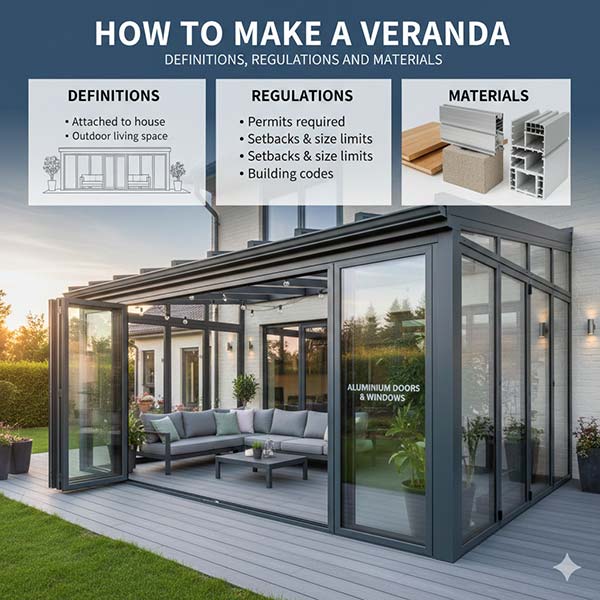
Building a veranda is a desire of many, as it allows balconies and terraces to be enclosed while making the most of their surface area. This article provides a guide on how to make a veranda: from the regulations to follow to the best performing materials.
Enclosing a balcony or terrace by transforming it into a veranda is a very effective solution for obtaining an extra room, especially in cases where the house is small or the tenants’ needs have changed. This new “room” can become an oasis of comfort that, thanks to high-performance windows and doors, allows the continuity between internal and external spaces to be experienced to the full.
To make a veranda at its best, it is recommended to proceed in the following way:
- understand specifically what a veranda is and what the advantages are;
- identify the most suitable type of veranda;
- know the relevant regulations and check that it is a feasible intervention in your specific case;
- choose the best materials (glass and aluminium) for the construction of the veranda;
- furnish the conservatory according to one’s own style, but also according to values of practicality and comfort.
What is a veranda and how it can be used
A veranda is an outdoor space that is covered at the top and can be closed on some or all sides. Closure is achieved by constructing a frame, which can be made of different materials such as aluminium, PVC, wood or steel.
The frame supports glass panes or, in any case, materials with features of transparency and impermeability, which open through sliding doors. It is not a totally independent room, but rests its structure on the curtain wall of the house or apartment building.
The advantages of building a veranda
By better understanding what a veranda is, the advantages of this type of construction are quite clear.
-
A veranda provides the possibility of making balconies, terraces, porches and gardens usable all year round. Without a veranda, these outdoor spaces would hardly be experienced, and perhaps even neglected, during the colder seasons.
- Even in summer, the closed veranda allows maximum use of the outdoor space on rainy days.
- With a veranda, you get additional indoor space compared to the square footage of the house. In this space, it is possible to create rooms for which the house had no space, such as a study, play area, fitness area or relaxation area. Or, one can redistribute the current rooms of the house to obtain, for example, a living or dining room with a view.
- In general, it can be said that the construction of a veranda significantly increases the level of living comfort in the home, as it can take advantage of an extra, bright and well-insulated space, in perfect continuity between inside and outside.
- The veranda is an enclosed space that does not need to be heated because it maintains a higher average temperature than the outside. It therefore allows heat to be stored and redistributed to the rest of the house, thus increasing its efficient energy use.
- The veranda is also an excellent solution for caring for greenery; functioning as a winter garden, it allows plants and flowers to survive in all seasons of the year.
- Building a veranda increases the total volume of the house, thus increasing its value.
- The veranda increases the level of insulation of the curtain wall to which it is leaning, thus improving the thermal and acoustic comfort of adjacent rooms.
Regulations and authorisations: what to do when closing a veranda
As it increases the volume of the house by providing it with an extra room for all intents and purposes, the veranda must comply with specific building regulations in order not to risk building abuse.
In particular, a feasibility study and a project, carried out by a professional such as an architect or surveyor, will be needed first. Accompanied by all useful documentation, the project must be attached to the request for a building permit or, depending on the municipality in which you are located, to the SCIA (Certified Declaration of Commencement of Activity). The permit will be issued when the municipal technical office has ascertained that:
- the house has residual volume to be used as a veranda;
- there is an adequate air-to-light ratio.
Once the work on the veranda has been completed, the change in the living space must be notified to the land registry office, which will update the building’s cadastral sheet.
The bureaucratic procedure for requesting permits varies depending on the location, so it is always a good idea to obtain detailed information from your local municipality. Finally, it should be remembered that it will also be necessary to request the opinion of the Superintendency of Cultural Heritage in the case of a veranda to be built in a place with a landscape or historical-artistic constraint.
How to close a veranda without a permit
It is possible to build a veranda on a balcony or terrace quickly and without the need to apply for a permit, while of course remaining within the scope of legality. The important thing, in this case, is that the veranda remains open on three sides because it cannot constitute an extra room by increasing the volume and value of the house.
This therefore corresponds to structures belonging to the free building industry: pergolas and metal tensile structures enclosed by curtains, as well as wooden or metal gazebos in the garden. Therefore, any structure made with removable frames and that is not anchored to the ground or floor is permitted, so that its eventual removal does not involve demolition work.
To sum up, it is only possible to build a veranda without the need for municipal permits if:
- the veranda is not made of masonry and does not represent a volumetric extension of the house;
- the veranda can be removed without demolition, so it is a mobile structure: not fixed and anchored to the ground, but only leaning;
- there are no historical, artistic or landscape constraints.
Building a veranda in a condominium
Even when building structures that are removable and/or open on three sides, thus in compliance with the law, if you live in a condominium, you still need to notify the administrator. Authorisation by the condominium assembly will also be needed only if the condominium by-laws expressly place restrictions on the closing of the building’s external spaces (such as balconies), and if the veranda significantly changes the appearance of the building’s curtain wall. Even in the case where the construction of a veranda does not require formal authorisation by the condominium, it is still good practice to present the project at the condominium meeting and to notify the condominium owners of the commencement of work.
In the planning phase of the works, it is then advisable to choose structures whose design is in keeping with the style of the building; in other words, it is important to build a conservatory that preserves the building’s decorum. Equally important is to build a structure that, both during and after the construction phase, guarantees total safety.
After the veranda has been built, the municipal technical office will of course have to change the cadastral data, just as the condominium’s dimensions will have to be updated on the basis of the new volumetric change in the flat in question.
The best materials for making a veranda
When deciding to build a conservatory, it is not enough to think about the type of structure, its orientation in relation to solar irradiation / radiation, and its position in relation to the house. It is just as necessary to think about the materials that will be used for the structure and the glazing.
Starting with the latter, there are many types of glass that can be chosen. For glazing, transparent, non-satinized glass is always recommended, so that light can penetrate the internal part of the veranda without obstruction. Also, on the basis of the orientation of the veranda, it may be appropriate to install low-emissivity glass, which allows heat not to disperse inside the veranda.
Depending on the different requirements, however, there are many other types of glass for the conservatory:
- sound-absorbing glass to improve acoustic insulation,
- coated glass to screen out excessive irradiation / radiation from the sun;
- armoured glass to maximise security against break-ins.
You can learn more by reading the guide to choosing window and door glass.
Finally, it should be remembered that there may be times when there is a need to screen the veranda glazing for greater privacy or to regulate the entry of light to one’s liking. In this case, sliding curtains will do an excellent job, but for even better performance, an effective solution is sunshades such as those proposed by METRA Building curtain walls, ideal in the case of verandas because they allow you to modulate the entry of brightness, sunlight and heat at will.
As far as the frame of the veranda is concerned, it is necessary to choose materials that are resistant and suitable for the construction of outdoor structures, thus exposed to weather and temperature variations. For a more rustic solution, wood is usually chosen; other materials commonly used are aluminium, PVC, steel and rabbet iron.
Of these, the absolute best because it is the most resistant and versatile is certainly aluminium.
The advantages of aluminium for conservatory construction
All materials used for conservatories have different features. Steel and rabbet iron are very durable, but involve a rather large investment. Wood makes for a rustic and refined-looking veranda, but it is not the best material for outdoor structures: it must be properly treated and maintained periodically to ensure adequate protection. PVC is a plastic material that does not always give the veranda an elegant appearance and, moreover, is not suitable for larger veranda structures.
Aluminium, on the other hand, has numerous benefits and, not surprisingly, is the material of choice for the construction of the vast majority of verandas in Italy. Its advantages are discussed in more detail in this article, but can be summarised as follows.
- Aluminium is a light and extremely resistant material and, therefore, ideal for the construction of structures that are in contact with the outdoors. The aluminium frame will withstand the harshest weather, the hottest and coldest temperatures, maintaining its qualities unchanged and very durable.
- Aluminium is a maintenance-free material that can be cleaned very easily. This provides a very pratical solution in everyday life.
- Aluminium is a 100 per cent recyclable material, so it fits perfectly in a context of low environmental impact; thanks to its thermic insulation capabilities, it guarantees the efficient energy use of the awning.
- Its ability to acoustically insulate and protect the interior of the veranda from draughts and mould growth significantly increases the living comfort of the veranda.
- Since the veranda is the most effective solution of continuity between inside and outside, it is important that it has the largest possible glass surface area, so as to ensure maximum passage of natural light. Aluminium also proves to be the best material in this case, as it is able to support even very large glass surfaces.
- Finally, aluminium can be customised in a wide range of colours and finishes, such as satin, sandblasted or wood effect, to make the structure of the veranda consistent with any architectural style.
Other elements to consider when building a conservatory
In addition to the frame and glass, it is important to design the veranda well in its entirety, without neglecting any details.
Very important are, for example, the attachments, which connect the awning structure to the wall of the house and the floor on which it is mounted. The connections must be of the highest quality, not only to ensure the solidity and safety of the structure, but also to ensure that the interior of the veranda is well sealed and protected against the ingress of rain, wind and seepage.
As the veranda is a real room in the house, it should be equipped with opening doors, usually sliding or folding, to ensure adequate air exchange inside. If this is not enough, it may be appropriate to install a ventilation system to ensure the right micro-climate and prevent the formation of mould and condensation. As we have seen, the aluminium frame is already an ideal ally for this purpose.
Finally, an adequate lighting system must be planned, so that the veranda can be put to good use even in the darkest hours of the day. If sinks or the like are planned in the veranda, the house water system must be extended to this space. If the veranda is used as a winter garden, a small irrigation system could also be installed to allow the most effective management of plants and flowers.