

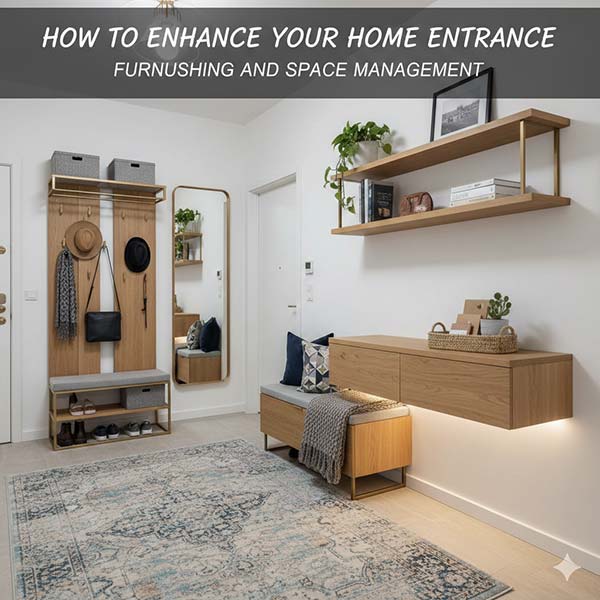
The entrance is a part of the home that is often underestimated when it comes to enhancing and furnishing spaces. Yet it is fundamental because it represents the home’s visiting card and influences the perception of those who enter it. In this article we offer advice on how to enhance the home’s entrance with specific structures and materials, but also with the most effective furnishings.
Entrance ideas for a modern home: practicality and cosiness
The entrance hall is an area of the home to be studied well, especially since it is not always easy to organise and furnish. Often, in fact, entrances are long and narrow corridors, or they are dark and not very functional rooms. But there are many tricks for transforming any home entrance into a really beautiful room in line with the style of the rest of the house.
Those who are renovating their homes in a modern key must keep in mind the two main functions of the entrance: practicality and cosiness.
Practical home entrance
The entrance hall is first and foremost a functional room. In fact, for example, as soon as people return home, they will need a space where they can support their keys, take off their shoes, hang up their coat, and so on. The entrance is a sort of ‘bridge’ between the outside and the inside, and must therefore serve the person entering by giving them the possibility of continuing on to the other rooms of the house without any encumbrances.
Cosy home entrance
The entrance is the environment in which you find yourself as soon as you walk through the door, and must therefore provide an immediate perception of comfort and welcome. The feeling of ‘feeling at home’ must be instantaneous. Furthermore, it should not be forgotten that the entrance represents the first impression that guests will make of the house and its mood; it must therefore be well cared for to make them feel welcome.
Mistakes to avoid when enhancing the entrance to your home
In order to achieve a truly welcoming, functional and visually appealing home entrance, the advice given in the following threads can be of great help. In general, meanwhile, it is worth reflecting on some mistakes not to be made when planning the management of the home entrance:
- Organise and furnish the entrance hall in a style completely different from the rest of the house. You would lose stylistic continuity in favour of a sense of bewilderment and confusion.
- Exaggerating with the colour palette. One would risk creating a confusing and tasteless visual impact.
- Overdoing it with furniture pieces. Especially if the entrance of the house is small, putting too much furniture and decoration in it risks being counterproductive, as it would become difficult to move around and use the space functionally.
- Do not think well about lighting. Poorly lit entrances or, conversely, over-lit by artificial lights can cause a feeling of coldness and carelessness.
- Using the entrance hall as a ‘jolly space’, where to accumulate objects of all kinds that cannot find space in the rest of the house. The entrance hall has its own specific function: filling it to overflowing would make it very untidy, preventing one from sampling a feeling of comfort and relaxation as soon as one enters the house.
How to enhance the home entrance
Every case has its own entrance: large or small, separate or in open space with the living room, dark or bright. In any case, there is always a way to make the most of it and turn it into the cosy, functional space that all homes need.
In order to understand how to enhance the entrance of a house, one can first of all start with various expedients that can help transform it radically. Beyond the pieces of furniture, there are in fact many interventions that can be undertaken.
Installing partition walls to divide space well
In recent years, many modern houses are designed so that the living area is a large open space.
In this way, those who enter immediately find themselves in the living room or kitchen. Some people like this solution but, if one has enough space in the arrangement, a small room simply used as the entrance to the house can really make a difference in terms of functionality, cosiness, privacy and elegance.
To separate the entrance area, one can use simple screens, perhaps made in a somewhat unusual style, or full-wall furniture that serves as a ‘bi-frontal’ library and storage unit, i.e. facing both sides.
The ideal solution, however, is provided by the partition walls. These are light and non-invasive structures that do not require any masonry work at all, but can transform a room completely. There are many different models of partition walls, each able to adapt to the different styles of the home.
Their function is precisely that of creating a space used exclusively as an entrance, so that coats and small objects can be left in a specific place before entering the rest of the living area.
For those who want to furnish their homes in a minimal, contemporary and refined style, glass and aluminium partition walls are perfect. Glass is a very special solution: it divides spaces without creating a clear barrier, thanks to its transparency that allows a glimpse of what lies behind the wall.
In this way, you get a well-separated entrance but do not lose the continuity between spaces; it is also the ideal solution if you have a somewhat dark entrance, as the glass lets the light from the living room windows through. If you prefer the entrance to be even more intimate, you can choose frosted, satinized glass, smoked or tinted glass to reduce transparency.
In any case, the aluminium structure supporting glass walls is indispensable.
In fact, aluminium is a material that lends itself beautifully to modern houses, even those built in more unusual architectural styles (such as the industrial style). It is durable, very easy to clean, has very elegant thin profiles and can be customised in a wide range of colours and finishes.
Making effective use of lighting
In order to make the entrance of a house really cosy, lighting is crucial. It is important to find the right compromise, so that the entrance is neither too much nor too little light, neither too warm nor too cold.
In more modern houses, the most popular solution is provided by spotlights embedded in a false ceiling. An alternative to the classic spotlights are LED bars, strategically concealed along the edges of the false ceiling or under furniture to create soft, dramatic lighting that is both functional and at the same time.
To give a touch of warmth and style, you can then choose wall sconces, floor or table lamps; they can also be true unique pieces that can furnish the entrance with personality. The ceiling chandelier should only be used if ceilings are high and if it does not get in the way of the door opening.
The lighting must therefore be well thought out, perhaps even with the help of an expert, to make the entrance area welcoming. It is important that the most practical areas of the entrance hall, such as shelfs or the coat wardrobe, are adequately lit in order to be able to move around with agility.
Giving a touch of colour to an entrance of personality
Colour has the ability to totally change one’s perception of a space, so it is worth considering it to make the entrance of your home visually larger, smaller or taller depending on the situation. For example, painting the walls of the entrance hall a light colour helps a lot to visually enlarge the space. If, on the other hand, the entrance consists of a long, narrow corridor, one can paint the short wall in a dark colour to make it more proportionate. Vertical threads, on the other hand, give the feeling of a higher space.
Colour can also be used to give a unique character to the entrance of a house. For example, you can decide to colour just one wall – or part of it – in a dark or bright colour, contrasting with the other walls. Another stylish alternative is provided by wallpaper, which is popular not only in classic houses but also in more modern ones. An entrance wall can therefore be decorated with a special wallpaper with geometric, figurative or abstract patterns for a decidedly unusual touch.
The important thing is that the colour or wallpaper should have some continuity with the style of the rest of the house. Also, if the entrance is rather dark, it is better to abandon the idea of dark colours so as not to accentuate this feature.
Using the right internal doors to circumscribe the entrance
In cases where one is renovating and therefore has the opportunity to design the entrance of the house from scratch, it makes sense to organise the space so that it is well separated from the rest of the living area. At this point, it becomes important to choose the look of the door that leads tenants and guests from the entrance to the rest of the house.
In this case, METRA Building’s aluminium internal doors are easy to match to any style in the home, from modern to classic. Enjoying very functional features such as resistance and extraordinary ease of cleaning, aluminium doors can take on any look thanks to the choice of different colours, different finishing, the use of decorative elements or glass inserts that can take on the most varied shapes.
If the internal door is not the most effective solution for the type of house one has, one can think of more creative solutions, such as the use of special curtains or the creation of arches that introduce the other spaces of the house in a fluid and elegant manner.
Don’t forget the importance of the front door
Although the front door is an element in itself, we should not underestimate it when we want to enhance the entrance to our home. If the entrance is the house’s calling card, in fact, the front door is largely part of it and can immediately provide a feeling of elegance and care.
If you are in a condominium, the choice of entrance door will most likely be subject to condominium constraints. However, you may choose to customise the part of the door that faces the entrance to your house, for example by painting it in a colour that contrasts with the walls or decorating it in a personal way.
In the case of detached houses, one can instead focus on choosing the entrance door that best suits one’s practical and aesthetic needs. METRA Building aluminium entrance doors are special because they adapt to many different styles. Real concentrates of design and technology, they are available in various models, colours and finishing: wood effect with glass inserts or blind inserts for more classic houses, milled panels in different colours for more modern houses.
Keeping the entrance tidy
This advice is different from all the others, but extremely effective in achieving a home entrance that is always welcoming and functional. It is pointless, in fact, to plan in great detail the features and furnishings of the entrance hall, if you then leave it in disarray. A disorderly space is in fact suffocating, confusing and even smaller than it actually is.
Tidiness, on the other hand, is synonymous with an airy space that welcomes tenants and guests in the best possible way, and where everything finds its place for maximum everyday practicality. In this case, specific pieces of furniture come to the rescue, which will be discussed in more detail in the next section.
How to furnish your home entrance: the necessary furniture pieces
As we saw at the beginning of the article, it is important not to “suffocate” the entrance of the house with too many pieces of furniture, or with furnishings that do not conform stylistically to each other or to the rest of the house. The aim is to create an airy, light and welcoming space, but with all the necessary elements to make the entrance practical and functional in its daily use.
Of course, individual pieces of furniture should be chosen according to the style of the house and one’s aesthetic preferences, as well as according to the size of the entrance hall. But regardless of this, it is important to provide for some or all of the following pieces of furniture, which are both beautiful to look at and dedicated to a specific use.
Consoles, cabinets, shelves
A first piece of furniture that should never be missing to enhance the entrance of your home is a shelf where you can support a variety of objects.
If the entrance is small and there is not a lot of space, shelves will suffice: even 15-20 centimetres deep are enough to create a very functional shelf. The shelves can be enriched with design knick-knacks, with clean and essential lines, as well as lamps; the important thing is to leave the necessary space for emptying pockets and for supporting your bag, mail and other objects.
If space permits, a console or cabinet can be used instead of (or in addition to) the shelf, as can a larger cabinet. The depth and length can be chosen according to the space available, while the height must be just right to support any object comfortably.
If supporting a console on the floor requires too much space, one can think of hanging on the wall not a simple shelf, but a small cabinet with at least one drawer, very useful for containing objects that must remain out of sight (emergency torch, spare keys, notepad…). A locker can also be an effective solution, i.e. aesthetically pleasing and practical at the same time, to hide the unsightly control panel that is almost always found in the entrance of a house.
Emptying tray
A tidy drawer is an essential element for any entrance: even the most minimal and essential must have one to maintain a high level of cleanliness and order in this room.
The tidy tray is a container used to support the small objects you have in your hand or pocket when you return home: house keys, car keys, wallet, sunglasses, and so on. However, it can also be a real decorative element in the entrance, acquiring different shapes, designs, colours and materials according to one’s taste.
Mirror
The entrance hall is not only the first room when entering a house, but also the last before leaving. From this point of view, the mirror becomes another fundamental element for furnishing the entrance, as it allows you to control yourself one last time before leaving the house. In addition, the mirror is also very useful as a furnishing element because it visually expands space, giving the perception that the entrance to the house is larger than it actually is. This is all the more true when full-wall mirrors are chosen or when several mirrors are placed opposite each other.
As in the case of the emptying tray, along with its practical function it can and must perform a decorative function, adapting to the style of the room in a coherent manner and, in some cases, providing a unique touch of personality. The ideal mirror, if space permits, is a full-length mirror: tall and narrow, with plain edges or framed in a classic or original manner. Otherwise, even a full-length mirror can be very useful: it can be chosen with or without a frame, with invisible hooks or hung in special ways, round, square or more abstract.
Coat cabinet
To avoid the clutter of coats, jackets, bags and accessories, a closed wardrobe is definitely necessary if space allows. In cases where there is not a lot of space but the entrance to the house has an alcove, this can be exploited by creating a sash enclosed space.
The ideal wardrobe is narrow and long to accommodate long coats. For a modern, minimalist style, it is best to opt for linear wardrobes, with concealed handles or spring openings, and made in neutral colours. When possible, embedding the wardrobe in the wall gives the entrance a greater sense of order, cleanliness and linearity.
Coat stand
If the entrance hall is small and lacks space for a real coat closet, one can fall back on the choice of a coat rack. It can actually also serve as an addition to a closed wardrobe, for example for hanging the most frequently used jackets, bags and other items.
If chosen carefully, in addition to its function the coat rack can also be a real piece of furniture and design. There are all kinds on the market, from classic to minimalist, as well as unique pieces that give the room character.
Depending on the arrangement of space and your own preferences in terms of use and style, you can choose between:
- wall-mounted coat rack. Perfect for a small space, they are space-saving and inconspicuous. They can consist of entire structures or even simple hooks to hang directly on the wall. There are also coat hooks in which the hooks completely retract into the frame when not in use, for greater space saving and an even cleaner view of the entrance;
- floor-standing coat hooks. Sufficient space is needed for them, but they give personality to the entrance with their varied shapes. They can be ‘hidden’ behind the entrance door or placed in plain sight. Their advantage is also the ease with which they can be moved as required.
Shoe cabinet
When wondering what to put in the entrance of your home, if you have sufficiently large rooms, you cannot do without a shoe rack. This storage unit is in fact extremely practical for storing all your everyday footwear, so that you will not be forced to walk around the house with your shoes.
In order not to take up too much space, the shoe rack should be very slim, the minimum depth necessary to accommodate all types of footwear. Slimmer models can be placed behind the front door, and their upper thread can serve as a shelf to support the shoe rack.
Pouf, bench or chair
To take off and put on their shoes comfortably, tenants and guests can make good use of seating designed specifically for this purpose. In the case of larger entrances, benches, benches or chests can be placed in a variety of styles, naturally always in keeping with the style of the shoe cupboard, wardrobe and all other furnishing elements. In the case of smaller entrances, one can opt for small poufs – which can then be moved as required – or multi-use solutions – for example, a bench placed above the shoe cupboard.
The seat can be chosen in fabric or velvet for added elegance, or in a more practical and easy-to-clean material such as aluminium4 , wood or plastic. A few cushions are enough to make this corner comfortable and beautiful to look at.
Umbrella stand
Among the indispensable furnishing elements for a home entrance is the umbrella stand. It must never be neglected, otherwise the entire room will be soaked and soiled when you come home on a rainy day.
The umbrella stand is therefore a functional object but, once again, can be chosen carefully to give a touch of character to the room. You can choose those that are more linear and essential, perhaps with brass or other metal finishes, or opt for more original shapes and decorations.
Carpet
While the external doormat has a purely practical function, the entrance mat plays a more decorative role and can make this space more welcoming. Depending on the mat one chooses, the mood of the entrance hall changes: elegant and refined, or cheerful and informal.
Based on the desired effect, one would then opt for carpets of different shapes, in neutral or bright and vivid colours, in abstract or geometric patterns with parallel shapes and lines.
As far as shape is concerned, a choice should be made:
- a rectangular carpet for a rectangular entrance;
- a round carpet for a square entrance;
- a walkway, long and narrow, in the case of a corridor;
- a more irregularly shaped carpet for very large entrances.
Paintings, sculptures and other decorative elements
Once all the essential elements for furnishing the home entrance have been positioned, the decoration can be completed with purely aesthetic elements. This is obviously to be assessed on the basis of the space left available and the coherence of styles and the ‘message’ one wishes to convey with the home entrance.
Paintings and illustrations can cater for any style preference: antique or modern, framed or unframed, alone or in compositions with others, in neutral or bright tones to liven up the home entrance. They are attention-grabbing elements, so it is important to study their position and choice with great care. An even more personal alternative is photographs depicting the occupants of the house; these can be black and white or coloured, with large or very essential frames. You can choose just one, large and representative one, or combine several in unique compositions.
Besides paintings, illustrations and photographs to hang on the walls or support on shelves, another decorative element is sculpture. Sometimes, in fact, a single piece of art is enough to give the entrance of your home a truly original character. Otherwise, you can opt for more discrete furnishing accessories such as candles and small knick-knacks that reflect the personality of the person living there. The important thing is always not to suffocate the space with decorations that are too excessive.
Plants and flowers
As a final touch to enhance the entrance of your home and make it even more welcoming, a bit of greenery is a must. It is the ideal solution to embellish and brighten up a space like this even on a low budget; just match them with the right pots which, in themselves, also have great decorative power. Depending on taste and available space, you can choose small or large plants, floor or hanging pots, or small pots of cut flowers that add colour.
If you are lucky enough to have an entrance hall with a window, there are endless possibilities. However, there are house plants that can withstand very well even in low light conditions and, moreover, have the ability to purify the air for greater living comfort in the home. Examples of such plants are aloe vera, azaleas, orchids, dracaena, Benjamin fig, snake plant or pothos.
Specific tips for enhancing and furnishing a small entrance hall
Modern houses and flats often have small entrances or, in any case, small spaces to create the entrance to the home. In this case, it is even more important to carefully choose the structural elements and furniture pieces to ensure that the room is always airy, light and uncluttered.
The first element to play with is colours: it is best to choose those in light, neutral tones, which give the optical effect of enlarging the space. The same can be achieved with specific geometric patterns, such as horizontal stripes in light tone-on-tone colours. If wallpaper is chosen, it should also be in light tones so as not to visually darken and shrink spaces.
One element that greatly helps to visually enlarge space is the mirror, which creates a true optical illusion of greater size and brightness. It is therefore worth dedicating a few corners of the small entrance hall to the placement of mirrors, especially if they are full-wall and are located one in front of the other.
With furniture, one must be careful not to create too much confusion. In this case, the elements to choose are those that are really essential: a small shelf on which to support the emptying tray, a shoe rack with an attached seat, a slim wardrobe or a wall-mounted coat rack. To increase the feeling of airiness, it is better to choose materials and shapes that give a sense of lightness: slender and linear frames, flat surfaces without too many frills, thin profiles.
It should also be noted that there are many types of multifunctional entrance furniture on the market. These are modular structures that can include, for example, a small closed wardrobe combined with a wall-mounted coat rack and mirror, or a coat rack with mirror and small chest, and so on. In this way, only one product is purchased to achieve a very functional and style-consistent home entrance. These solutions are particularly suitable in the case of small entrances, where one does not want to give up the most functional furnishing elements by using every single available inch.
Finally, from a decorative point of view, it is certainly worth choosing paintings, photographs, lamps, room scent diffusers or other elements that give the room character; but never without overdoing it. When hanging objects on the wall, one should always leave some space for technology and service elements, such as the video intercom and the cabinet of the home automation system.