

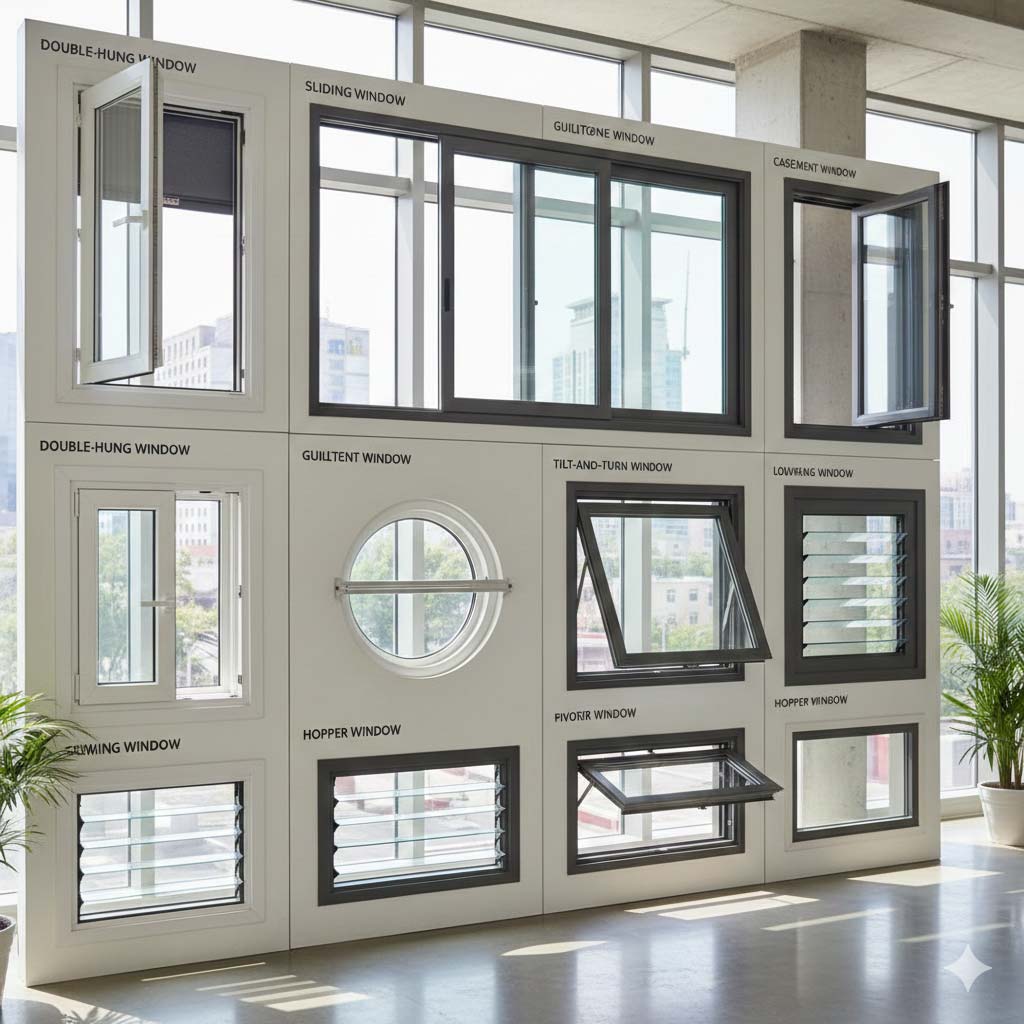
The windows in a house are chosen on the basis of material, finishing, design… but the opening is also an element to take into account, as it can greatly influence the window’s functionality. There are different types of window openings, all of which fall into the main categories of ‘casement’ or ‘sliding’.
This article gives a comprehensive overview of them, describing their features and providing advice on which opening to choose according to your needs.
How many types of windows are there?
The window performs many structural and aesthetic functions within a house. Certainly, one of its essential features is that it can be opened to facilitate the passage of light and air between the external and internal environments of the home.
The window opening is an element that is often taken for granted, but which should be analysed in more depth in order to be able to choose it in the most effective way. In fact, there are many types of opening (window). Each of them has specific features and can influence in no small measure some essential functions of the window itself, such as ventilation capacity and space utilisation.
A window can be chosen on the basis of several elements, first and foremost the material. In this case, undoubtedly between aluminium, wood and PVC, it is the former that offers the greatest benefits in terms of resistance to atmospheric agents, durability over time, thermic insulation and soundproofing, the need for very low maintenance and considerable aesthetic customisation.
Another element on the basis of which to choose a window is its type of opening and, in this case, there is no better option than another. In fact, one type of opening can only be more suitable than another depending on the specific conditions of the house and its different rooms, as well as the user’s preferences.
Let us therefore see what types of windows exist, categorising them into two main groups: casement windows and sliding windows (whose main differences can be explored in this article).
Opening typologies of windows: casement windows
Casement windows are the most common in Italy. These are those windows that open by means of a pivoting mechanism: there is one or more sashes, which open towards the inside of the building by pivoting on one or more hinges fixed on the side of the sash and frame. This generic definition can be explored in more detail in the article dedicated to casement windows, and there are however exceptions which we will see in a moment.
There are several casement opening options.
Fixed sash
Although not a true opening, this window is commonly included among casement windows because it is usually found in combination with windows of this type.
It is simply a window that cannot be opened, but remains fixed. It is made at a low cost and ensures the passage of natural light, but not air.
When made of aluminium and/or in a curtain wall context, the natural light entering through this type of window is maximum, because the window consists almost entirely of the glass pane and its structural profiles are very minimal.
Outward casement opening
The casement provides vertical sashes, both to limit overall dimensions during opening and to support static stress. Several casement windows can be combined, resulting in double, triple or even more casement windows.
If the casement opening with the sash opening towards the inside of the building is very common, the casement opening towards the outside is much less common, at least in Italy. The sash that opens towards the outside of the house saves a lot of space inside the room, because there is no need for the sash to take up overall dimensions when the window is open.
The outward opening casement window is therefore an ideal solution for very small rooms, as well as for rooms where access to the window may be restricted. Curtains or other decorative elements, such as plants or ornaments, can also be installed near the window without the fear that they will be disturbed by the sash opening. The cons of this type of opening is the difficulty in reaching every point on the outside of the sash in order to clean it effectively.
Bottom hung opening
In this case, the turning hinges are not on the side, but on the short, low side of the sash. In this way, the sash only opens at the top, towards the inside of the room.
This type of opening is very functional for letting air through and eliminating unpleasant odours, without having to open the sash completely and taking up space. It also allows the window to be left open for a long time, without compromising safety in the home. It is therefore ideal for small spaces where air exchange is often necessary, such as bathrooms and kitchens, but also for spaces such as attics or basements.
Tilt-and-turn opening
This window combines the advantages of a casement window and a bottom-hung window. It is a casement that opens normally as a sash, but when the handle is turned by 90°, a sash-like opening is achieved.
In this case too, it is the optimal choice when there is a need for continuous ventilation without opening the window completely, such as in the bathroom or kitchen; the controlled sloping allows good, constant ventilation while maintaining security and privacy. The possibility of opening the window in one way or another makes this type of opening very versatile and practical, perfect for modern living spaces where functionality is at the centre.
Projecting opening
Also called ‘compass-leg’, this is a special version of the bottom hung opening, in which the hinges are on the high short side of the sash. The sash will thus open only at its rear, and outwards.
Although less common, this type of opening has several advantages: there is good air circulation while avoiding the need to open the window completely, as well as the entry of rain and wind; furthermore, the outward opening means that not even the slightest space is taken up inside the room. For these reasons, it is a very suitable window for commercial and public contexts, such as schools and offices.
Pivot window (horizontal or vertical)
The last type of opening is the pivot or tilt window. In this case, the sash rotates on a central axis by means of two mirror pivots placed on the sides of the window (horizontal pivot window) or on its short sides (vertical pivot window).
An opening of this type is primarily chosen by those who put aesthetics first, especially in the case of large windows with single glazing. However, it can also be the ideal solution in cramped spaces or to facilitate cleaning. A very common example of a pivot window placement is in the kitchen, above the work counter.
Opening typologies of windows: sliding windows
Sliding casement windows are less common than casement windows, but are nevertheless very widespread in our country, especially in the French window version. These are windows that open by means of a sliding mechanism: one or more sashes slide on tracks, moving sideways and allowing air to pass through. This generic definition can be further detailed in the article dedicated to sliding windows.
There are several sliding opening options.
Horizontal sliding opening
When talking about sliding openings, the horizontal one immediately comes to mind because it is the most common. In this case, one or more window sashes slide on tracks – more or less hidden – to move sideways, sometimes overlapping.
They are particularly appreciated in modern rooms, as well as in all rooms where one overlooks terraces or gardens. They allow a panoramic view and controlled ventilation – because they can be opened only as much as is deemed necessary – without overall dimensions on the internal part of the house. The resulting aesthetics are often clean and essential, thus perfect for minimalist houses.
Vertical sliding opening
Also known as ‘vertically sliding windows’ or ‘guillotine windows’, vertical sliding windows are less common, but still very present especially in historical and prestigious urban contexts. Due to its essential lines, it is also increasingly used in more contemporary contexts.
In this case, there is a fixed window upper part, and a lower part representing the movable sash, which slides upwards via vertical side tracks. The sash can be raised in a simple and adjustable manner, allowing the air passage to the interior to be modulated.
Folding sliding opening
Also called ‘accordion’, ‘folding’, or ‘packet’, this window has a very evocative name, as its sashes open by folding in on themselves just as if they were the folds of an accordion or the pages of a book. The sash will therefore project (either towards the inside or the outside of the house), but will allow an almost total opening and, therefore, a much higher level of communication between the external and internal environments.
The folding opening is mainly used in patio doors, and is recommended for those large houses where the glazing can be opened almost completely to create a kind of ‘open-space’ between the house and the terrace or garden it overlooks.
Pivoting opening
This last type of opening is very special, as it combines the typical translation mechanism of sliding openings with that of an up-and-over opening. The vertical rotation axis allows the sash to open fully, thus offering complete panoramic views and a high passage of air and natural light.
The dramatic effect offered by this window is suitable for lofts, penthouses and spaces supporting large glass surfaces, where the aim is to create an aesthetic effect with impact.
Window openings: how to choose them according to your needs
As we have already seen from the descriptions of the different window openings, they have different features, and their choice will therefore depend on several factors.
Below are some elements to take into account when choosing the type of opening (window).
Arrangement space
As detailed in this article, every room has its own window. In fact, every space in the house has different features, which are also matched by different types of windows. One of the main features is certainly the size.
In the case of small spaces, you will need windows that do not require a lot of space to open the sash: green light, therefore, to sliding, tilt-and-turn or bottom-hung windows. In larger rooms such as the living room, on the other hand, you can opt for casement or folding windows, which allow optimal ventilation and a more panoramic view to the outside.
Ventilation and living comfort
The use of windows also has a lot to do with living comfort in everyday life.
If you want to live well in your home, you will need spaces that are always well ventilated and ventilated, as well as the possibility of creating continuity between internal and external environments (such as gardens or terraces). It is therefore appropriate, for example, to choose a tilt-and-turn or sash opening for those rooms, such as the kitchen and bathroom, which require light but constant ventilation throughout the day. On the other hand, when there are large glass surfaces that face onto open outdoor spaces, openings such as folding or pivot window openings allow maximum enjoyment of natural light and air exchange.
Security and privacy
Privacy is also an essential element to consider when choosing windows, as they are the main point of communication with the outside. In the bathroom, for example, it is useful to choose a bottom-hung or bottom hung window, which allows easy ventilation without compromising privacy (which can in any case be guaranteed by satinized glass, as explained in the guide to choosing glass for windows).
Projecting or pivot opening, especially in rooms such as the kitchen, also allows safe and controlled air exchange without necessarily having to open the window wide.
Aesthetics and design
As is well known, the window contributes a large dimension to the decorative impression of a room. This is mainly due to the frame material and type of glass, but also to the type of opening chosen. For example, generalising, it can be said that casement windows are perfect for rustic and traditional contexts, while sliding windows are better integrated in more modern and minimalist styles.
In design houses where the aim is to impress, but without sacrificing functionality, special openings can be chosen , such as tilting or pivoting.
Choosing different window openings with METRA Building
Undoubtedly, choosing the best windows is no small task, as they play a key role in the comfort, functionality and aesthetics of rooms. As we have seen, the window opening can have a decisive impact on all these elements, and must therefore be chosen with great care.
A good idea is to rely on professionals in the sector, who know how to advise on the right window opening for each room in the house and for each particular need.
METRA Building has expert dealers throughout Italy, who can put their knowledge at the service of the customer.
The METRA Building catalogue offers a wide choice in terms of window openings:
- casement windows include one or two normal or tilt-and-turn, tilt-and-turn, parallel sliding bottom-hung, horizontal or vertical sliding bottom-hung, one or two sashes with outward opening;
- between sliding windows, there are 2 sashes, 3 sashes on 3 tracks, 6 sashes on 3 tracks.
METRA Building windows and doors are made of aluminium, the material that offers the widest and most effective advantages when it comes to a quality window and door.
All METRA Building windows can be integrated into the home’s domotics system to automate and facilitate the operations of daily life.