

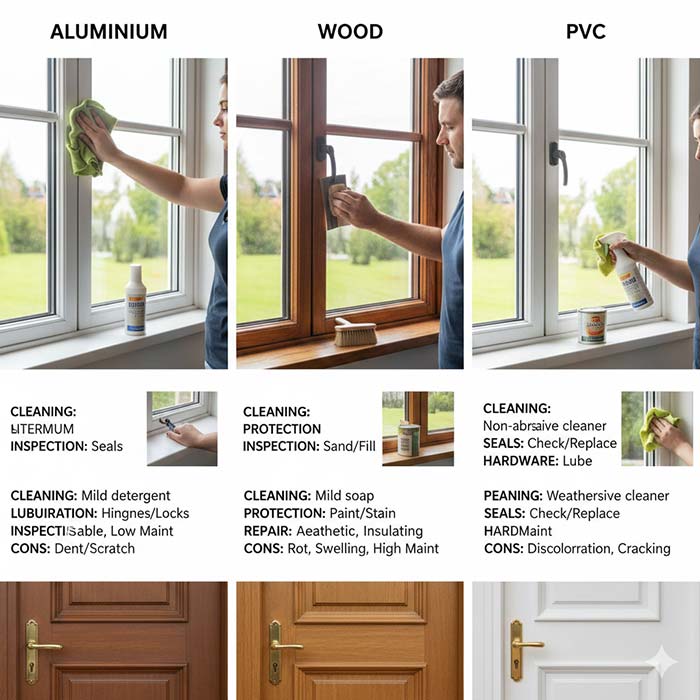
Why it is important and how to do it for aluminium, wood and PVC
As fundamental elements in the comfort of the home, windows and doors must be controlled periodically to ensure their proper functioning. This article defines the different concepts of window and door maintenance, explains why it is important and provides tips on how best to maintain aluminium, PVC and wood windows and doors. It will be easy to realise that aluminium windows and doors have lower maintenance requirements.
When it comes to choosing a quality window and door, people often focus on its technical features: its resistance, durability, thermal and acoustic insulation capacity, and so on. But one must also bear in mind that the window and door chosen will not remain the same for long as it was when it was purchased; daily use and the wear and tear of time will slowly but gradually reduce its qualities.
In order to keep them in good working order and ensure that they last over time, it is therefore essential to provide adequate maintenance of windows and doors; maintenance that can be both routine and planned. Nevertheless, as we will see below, some materials – such as aluminium – require very little maintenance and can therefore be considered extremely practical in everyday life.
What is window and door maintenance and why is it important
Especially in their parts in contact with the outside, windows and doors tend to diminish in their performance effectiveness over time. This is mainly due not only to simple wear and tear, but also to exposure to sun and weather. When this happens, the window and door may no longer guarantee a perfect seal, resulting in annoying draughts and difficulty in opening and closing the window. It may no longer be able to keep the house safe, prevent heat from escaping to the outside, and act as a barrier to noise from outside.
Window and door maintenance serves to eliminate these possibilities or, at least, to delay them as long as possible. While some materials, such as wood, have always required maintenance, aluminium and PVC require much lighter maintenance. Nevertheless, the small components of windows and doors, such as hinges and gaskets, must be controlled from time to time to prevent extremely high-performance windows and doors such as those in aluminium from gradually losing their effectiveness. On the other hand, a window and door is made up of mechanical parts that, being in motion every day, must be controlled so that this movement does not wear them out in the long run.
It is therefore necessary to carry out window and door maintenance in an organised and punctual manner, according to procedures that involve all the components of the window and door and that can be carried out DIY or by a specialised technician. The important thing is never to skip routine and scheduled maintenance appointments: even when windows and doors still look aesthetically perfect, this does not mean that they really are.
It is worth remembering that, in the case of strong windows and doors such as those in aluminium, we are not talking about daily or in any case very frequent maintenance; it is sufficient to carry out a check every 6-12 months or so to ensure that all the parts of the window and door are still at their best. It is therefore a minimal, yet essential, check.
How window and door maintenance is carried out
Routine maintenance basically consists of a periodic check of the windows and doors, to assess their condition and assess whether to replace certain parts or the entire window and door. This maintenance is carried out according to the instructions provided by the supplier and/or contained in the window and door booklet supplied at the time of purchase. Since 2010, in fact, it has been mandatory for the window and door manufacturer to provide the customer with a use and maintenance booklet for windows and doors, with all the information needed to take effective care of them.
Routine maintenance means:
- carry out a more thorough cleaning of windows and doors than usual, insisting even on the smallest and most insidious components such as gaskets, hinges and drainage slots, which should be meticulously cleaned with a small brush;
- check that the opening and closing movement still functions correctly. This applies to casement openings, such as tilt openings, as well as sliding openings;
- lubricate hinges, handles and locks with specific lubricants;
- treat the gaskets with specific products with the aim of keeping them intact and elastic over time;
- if necessary, treat the window and door profiles with suitable oils and products, for example to maximise their water-repellent qualities;
- assess whether it is necessary to replace gaskets or other components;
- if the windows and doors are now more than 20-30 years old, assess whether routine maintenance is still sufficient or whether the windows and doors need to be replaced to breathe new life into the house5 and maximise efficiency.
Routine maintenance can be done do-it-yourself, or by hiring a company specialising in window and door maintenance. The choice depends on one’s skills and competence in the matter, the budget available and the time one is willing to devote to the windows and doors of one’s home.
These are, however, very deferred in time. In fact, if window and door cleaning can take place every 2-3 months, ordinary maintenance can be carried out once a year. However, it is better to perform it every 6 months if windows and doors are exposed to more aggressive weather conditions, as in the case of seaside homes, or to potentially harmful elements, such as pollen or very resinous trees.
Although the ordinary maintenance of windows and doors must be carried out regardless of the material used to make them – as it is mainly a matter of taking care of the smallest components – aluminium windows and doors guarantee a longer lifespan with the same maintenance. This is because aluminium is in itself an extremely resistant material to agents such as rain, wind, extreme temperatures, salt and high irradiation / radiation from the sun. METRA Building aluminium windows and doors, for example, guarantee excellent performance over time thanks to the use of small, high-quality components.
How to carry out scheduled window and door maintenance
The maintenance of windows and doors is not just ordinary maintenance; there is also scheduled maintenance of windows and doors. It involves a series of checks and interventions that are scheduled in advance and will then be carried out by a specialist technician or by the company that sold and installed the windows and doors.
Although formally different from ordinary maintenance, planned maintenance aims at the same objectives: to maintain the performance of windows and doors over time, preventing possible failures and preserving their effectiveness for guaranteed living comfort.
In fact, performing scheduled maintenance means:
- check the perfect opening and closing mechanism of the sashes;
- check that all sealant components are still in good condition, without small holes or imperfections of any kind;
- check the condition of handles, locks, hinges, screws and all window and door hardware;
- check that any coating on the window and door is still in good condition;
- in general, check that the window or door still perform its functions to the best of its ability, protecting the house from draughts, mould or infiltration.
Scheduled maintenance is of enormous importance because it must be entrusted to the knowledge of someone who works in the industry and knows exactly what and how to check. It is therefore important to know how to rely on the right technician. Even better, it is important to purchase your windows and doors from a dealer who knows how to guarantee impeccable scheduled maintenance, so as to take all your worries away. METRA Building provides its customers with the utmost experience and expertise also in terms of scheduled maintenance, to make its already high-performance aluminium windows and doors even more efficient over time.
Extraordinary maintenance: when to do it
Fortunately, just as the name suggests, extraordinary maintenance should only be carried out in specific circumstances: when even ordinary and planned maintenance have failed because the window and door is too old or has suffered extensive damage.
Extraordinary maintenance basically consists of replacing windows and doors or some of their substantial parts. This can occur either due to the ageing of the window and door, or due to the desire to equip one’s home with a better-performing window and door, perhaps in order to ensure more efficient energy use.
Replacement can take place in several ways:
- choosing a larger window;
- choosing a different shape and colour to the original window and door;
- transformation of a window into a French door;
- installation of window alarms or armoured windows, and so on.
In all these cases, it is advisable to choose new windows and doors that guarantee very high performance over time, not only in terms of energy saving, but also in terms of thermic insulation and acoustic insulation, resistance to atmospheric agents and anti-burglary security. All this is guaranteed by thermal break aluminium windows and doors, such as those proposed by METRA Building.
Maintenance of aluminium windows and doors
Aluminium has countless advantages as the material of choice for window and door frames; it is no coincidence that it is increasingly loved by those who wish to live in the latest generation of houses, combining efficiency, technology and aesthetics.
Light, durable and easy to work, aluminium is loved above all for its extraordinary resistance to the most violent atmospheric agents, for the security it offers the home and for its incredible ease of customisation in terms of shapes, colours and finishes. It is a metal with innumerable properties that fits perfectly in modern contexts; it is chosen for those who love minimalist style or for those who dare with an industrial style. In reality, however, aluminium is also able to adapt to more classic cases, because it has a refined allure that other materials, such as PVC, cannot guarantee.
Another huge advantage of aluminium windows and doors is that they are very easy to clean and maintain.
Although we cannot speak of ‘zero maintenance’, aluminium windows and doors only need to be controlled once a year to check that gaskets, hinges and other components are in good condition. The aluminium frame itself hardly requires any maintenance, as it does not corrode, is resistant to rust and, thanks to painting or oxidation, keeps its colours vivid and unchanged over time.
So how should aluminium windows and doors be maintained?
From time to time – every 4-5 months – simply wipe the surfaces with a damp cloth, with or without a neutral cleaning agent, to remove dust and any stains.
Once a year, ordinary maintenance of its components will then be carried out, checking whether the gaskets are still perfectly intact and, if necessary, lubricating hinges and handles with appropriate products. The only caution in the cleaning and maintenance of aluminium windows and doors is not to use abrasive cleaning powders, metal scrapers, steel wool or acid solvents, as they could ruin the metal and the performance of the window and door.
Wood window and door maintenance
Unlike aluminium windows and doors, wooden windows and doors require more careful maintenance. Wood is undoubtedly a valuable material, chosen by many for the feeling of warmth, cosiness and elegance that it gives to the home. It is a natural product with a thousand resources that adapts very harmoniously to classic, rustic or Nordic style houses.
Despite its good properties, one of its disadvantages is maintenance, which must be carried out with even more care and attention than normal because wood, as a natural material, can catch deterioration over time.
The cleaning of wooden windows and doors should be carried out quite frequently, especially with regard to their exterior in contact with atmospheric agents and pollution; even in the case of wood care, it is essential to avoid aggressive chemicals. After cleaning, the wood should also be treated with waxes or oils to give it a healthy appearance.
Less frequently but still fairly periodically, and of course depending on the needs and age of the window and door, it should also be carried out:
- treatment, i.e. the application of a specific restoring product to give brightness and gloss to the existing paint layer;
- refinishing, i.e. the repainting of altered, dented or cracked wooden parts;
- the refresh, i.e. the total painting of the frame. Before the refresh, the frame must be thoroughly cleaned and then an abrasive paper must be used to remove the current painting layer;
- renovation, i.e. total repainting preceded, however, by a plastering operation and a coat of impregnating agent.
These operations serve not only from an aesthetic point of view, but also to ensure that the window and door’s performance is maintained. As can be easily imagined, they require much more effort than aluminium windows and doors, and are often tasks that many people do not feel safe to carry out themselves.
Unfortunately, wood can be easily attacked and damaged by UV radiation, mould and fungus, pollutants, excessive humidity and sudden changes in temperature. It is therefore not ideal to make windows and doors that are easily exposed to all these factors. For those who do not want to give up the warmth of wood in their homes, however, it is possible to combine wood and aluminium to get the best out of both materials. METRA Building’s aluminium-wood line was created precisely for this purpose: to guarantee comfort and elegance on the inside, resistance and high technical performance on the outside.
PVC window and door maintenance
PVC is a plastic material that, although it does not give the house a particularly elegant feel, is nevertheless high-performing from a technical and structural point of view. It is weather resistant and can be customised in different colours and finishes, although often with poorer aesthetic results than aluminium windows and doors.
PVC does not require much maintenance: certainly, much less than wood. Routine cleaning and maintenance operations are rather similar to those of aluminium windows and doors. This basically means cleaning with a cloth and a neutral cleaning agent, as well as checking (roughly) annually that hinges, handles, locks, gaskets and all other small components are in good condition. Also in this case, it is important to take due care of the gaskets – without using acidic or abrasive products – and to lubricate the mechanical parts if necessary.
A maintenance operation for PVC windows and doors is that of restoration. It must be carried out in the case of PVC frames with abrasions or scratches, or if they have lost their lustre. To carry out the repair, specific pastes or kits are available on the market, the use of which makes it possible to masked light scratches and give new vigour to the window and door frame. In this way, the need for repainting is avoided.
Painting PVC windows and doors is a counterproductive operation, as it may cause the frame to become fragile. This is a disadvantage of PVC windows and doors, as they cannot be painted to obtain colours and finishes to meet the most diverse aesthetic requirements, as aluminium windows and doors are able to do. To obtain colours and finishes on PVC windows and doors – which are simply white in their natural state – very thin coloured films are therefore applied. The films must be maintained and cleaned with great care because, over time and when exposed to strong irradiation or severe weathering, they may discolour or peel off, causing a significant impoverishment of the window and door’s aesthetic impact.
For this reason, with the same ease of cleaning and maintenance, and especially in the case of windows and doors in particular colours or finishing, it is always advisable to choose aluminium windows and doors.