

What are Thermal Bridges and how to eliminate them
Because they have a direct influence on the home’s living comfort and efficient energy use, thermal bridges are one of the most critical elements in the thermal design of buildings. This article explains what a thermal bridge is, what it can be due to and, above all, how to prevent and eliminate it to make the home more efficient, comfortable and sustainable.
Thermal bridges: meaning?
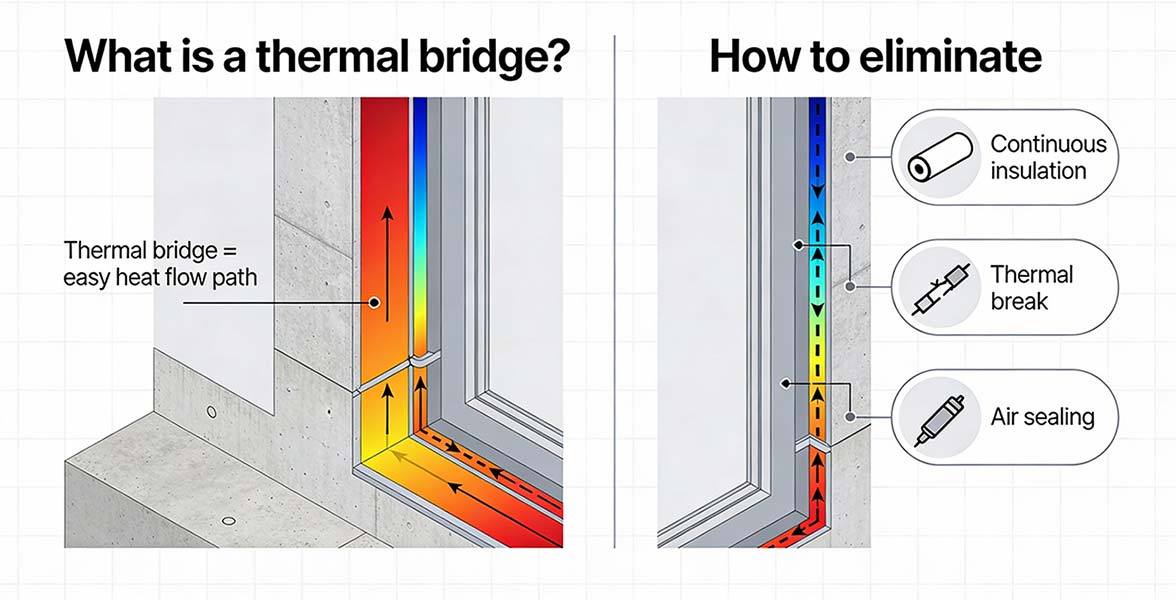
A thermal bridge is a localised region within a building where the heat flow is much greater than in the surrounding areas. This difference causes a ‘point of discontinuity’, which in turn creates heat loss between the interior and exterior of the building. In other words, these points of discontinuity become actual pathways through which heat escapes to the outside of the building.
The thermal bridge is therefore a weak point in the building envelope; something that cannot be seen with the naked eye but which can be perceived in the thermal discomfort of the rooms in which one lives, and which can cause the loss of up to 30% of the heat generated by one’s heating system.
There are two types of thermal bridges.
Structural thermal bridging: is created when heterogeneous elements are present in the structure of the building. For example, when two materials with different thermal conduction capacities are brought together without adequate insulation dimensions, a structure thermal bridge could be created at the contact points between these two materials, as the transition from one to the other would create a discontinuity in thermal resistance.
Form bridging: is created for basically the same reason (a discontinuity in the thermal resistance of the building envelope), but due to variations in the shape of the envelope itself. Variations in shape are defined as the presence of recessed or protruding edges, restrictions, junctions or walls placed in discontinuous positions.
What causes a thermal bridge?
As can be seen from its definition and classification, the phenomenon of thermal bridging occurs when there are interruptions or discontinuities in the thermic insulation of the building envelope. Mainly, therefore, thermal bridging is created in the presence of pillars, beams or any other element that leads to the existence of edges and ‘steps’ in the walls. Elements such as floors, balconies or window sills can also cause thermal bridges if they are not properly insulated at their joints.
Of course, the presence of thermal bridging is also due to a window not performing its thermic insulation function adequately.
This may be due to:
- poor quality or deterioration of structural elements and junctions;
- poor material quality, or materials with different thermal properties;
- inadequate window and door installation.
Alone or together, these phenomena create preferential pathways for the loss of heat, thus generating thermal bridges.
The consequences of thermal bridges in the home
Thermal bridging is a phenomenon that no one wants in their homes, because its presence can have a very significant impact on energy costs and living comfort. In a context of home energy redevelopment, therefore, correcting existing thermal bridges is absolutely essential.
Rising energy costs
The thermal bridge is nothing more than an area where the loss of heat to the outside is facilitated for all the reasons seen above. This means, therefore, that a good percentage of the heat generated by the house’s heating system will be totally wasted. Energy losses through thermal bridges will therefore require more effort from the heating (but also air-conditioning) system to heat or cool the house.
This will obviously have a negative impact on the costs incurred for heating the house, especially in the long term. And a further negative consequence is the strong impact such an energy effort would have on the environment and eco-sustainability.
Presence of moisture, mould and condensation
The temperature discontinuity caused by thermal bridges can favour the formation of condensation on the glass surfaces of windows and, above all, mould in the regions surrounding the window, pillars or anywhere where the thermal bridge itself is present.
In the long term, mould can spread to the point of posing a tangible danger to the solidity of the building.
But that’s not all: the presence of mould and condensation, as well as an imbalance in the humidity level, can compromise the house’s internal micro-climate and air quality as well as encourage the proliferation of bacteria, thus causing potential health problems in those living there.
Thermal discomfort
Rooms affected by thermal bridging are not very comfortable from a thermal point of view, as the occupants will experience temperature differences that are also very uncomfortable. As well as wasting energy and money, the inability to manage and optimise your heating and air conditioning system creates a sense of frustration, discouragement and loss of comfort that should be essential in your home.
Thermal bridging: how to eliminate and prevent it
If you are building or renovating a case, it is essential to carry out all processes that allow the building envelope to be well thermally insulated, thus avoiding the formation of any thermal bridges in the future.
In the case of a new construction, one can work from the outset to design a building in which thermal bridges really struggle to form. In the case of renovations of existing buildings, some structural elements often cannot be changed – think of the presence of load-bearing pillars, for example. However, it will be possible to carry out some work to remove those thermal bridges that can be removed, as well as to minimise heat loss in general terms.
Performing an advanced thermal analysis
In the case of building a house from scratch, but also of a massive structural renovation, there is the possibility of carrying out advanced thermal analyses of the building, making use of 3D modelling and specific software for calculating thermal bridges.
Such tools provide a detailed and accurate view of potential critical points in the building envelope, i.e., those where thermal bridges are most likely to be created. During the design phase, analyses of this type can help to make targeted corrections to the design itself, optimising the qualities of the materials and insulation techniques chosen.
Choosing high thermic insulation windows
While it is true that one of the main causes of thermal bridging is poorly performing windows from a thermic insulation point of view, it goes without saying that the best way to eliminate and prevent thermal bridging is to choose windows that are effective from this point of view.
In this respect, it is worth getting well-informed and relying on professionals2 , who know how to recommend the highest quality materials and elements to ensure maximum thermal tightness. It is mainly a matter of choosing glass that performs well from this point of view – also based on the specific needs of your home – as well as joints, silicones and other accessories.
From the point of view of the material used to make the window frame, it can be said that all those most commonly used – aluminium, wood and PVC – offer adequate thermic insulation. Obviously, this happens with the same quality: choosing a low-cost PVC window and door frame, for example, could lead to window and door buckling and consequent heat loss over the long term. In aluminium frames, such as those proposed by METRA Building, it is the thermal break that makes the difference: an insulating material is inserted between the internal and external profiles of the window and door. More on thermal break definitions and details here.
Ensure correct installation
As much as window solutions and materials can guarantee excellent thermal insulation and the absence of thermal bridging, this can easily be undermined by incorrect installation. Installing a window or door means fitting it correctly so that the point of contact between the frame and the wall is perfectly insulated and functional.
One must therefore make sure to rely on professional installers to avoid rendering the investment made in thermal and energy savings useless. You can learn more about the concept of laying in this article.
Using innovative insulating materials
Very often, in the presence or absence of a thermal bridge, it is the use of insulating materials that makes the difference. For example, special rigid foams or insulating panels with a low thermal bridge can be implemented. In the thermal break of METRA Building aluminium windows, noble gases with very high insulating power are used, thus guaranteeing the absence of heat loss through the window frame.
Protecting the building envelope with an exterior insulation and finish system
Thermal insulation consists of the application of insulating materials to the building envelope in order to increase its insulating power and eliminate or minimise the problems of heat loss through thermal bridges.
Thermal insulation can be external or internal, depending on whether the insulating material is applied to the external or internal surface of the house. Both are valid solutions, which must be chosen on the basis of the specific needs of one’s home. It is always good to remember that any internal thermal insulation would reduce the usable internal space.
An alternative to thermal insulation is blown-in insulation, which means the insertion of specific insulating materials inside wall hollow spaces (when such hollow spaces are present).
Prevent and eliminate thermal bridges with METRA Building windows
Thermal bridges represent a real challenge in the design and energy management of buildings. When building or renovating your home, it is essential to turn to professionals who know how to advise on the right approaches to avoid energy costs and thermal discomfort in the long term.
METRA Building offers doors and windows that always guarantee excellent thermic insulation, to prevent the formation of thermal bridges, mould and condensation, thus obtaining an energy-efficient house that is very comfortable to live in.
This is due to the high quality of the elements that make up METRA Building products: from the gaskets to the mechanical parts and, of course, the structural elements, which are made of the highest quality aluminium. In addition to the numerous advantages of aluminium as a window material, the presence of thermal break guarantees excellent thermal insulation of the building, thus preventing any loss of heat.
Installation is also fundamental, as we have seen. METRA Building uses the PosaClima system, currently the most popular laying system in Italy and compliant with all the most stringent legal requirements on the subject.
Finally, continuous research and development is necessary to find new methods of efficient energy use and better performing insulating materials. In this sense, METRA Building adopts a technological and innovative approach, carrying out continuous research and analysis to ensure increasingly comfortable and sustainable living environments.