

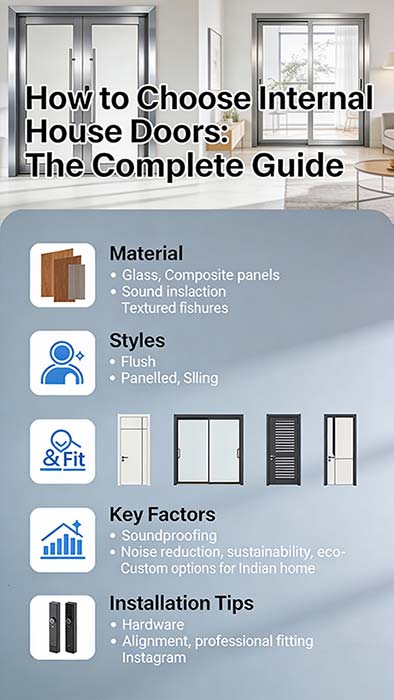
Internal doors primarily serve to separate and define spaces, but they can also contribute to giving character and style to different rooms. For this reason, the choice of internal doors is a fundamental part of designing and furnishing a home. In this article, we explore the various aspects of choosing internal doors: types, materials, colours, combinations and more.
4 elements to consider when choosing internal doors
Even before understanding the types of internal doors and their different features, it is important to consider some elements that can help make a more considered choice, as these elements will influence both the functionality and aesthetics of the internal doors themselves.
Architectural and house design style
Every case has its own dominant style: classic, modern, minimal, shabby chic, industrial, eclectic, marine… To maintain harmony and cohesion within the boundaries of that style, it is important that all the various elements of the house are consistent with each other. Internal doors should therefore also match the style of the house. For example, if you have the desire to build or renovate a modern home with contemporary and sophisticated tones, you will probably choose materials with clean, streamlined lines such as aluminium.
Measures and opening
After having clarified the style of the house to which the perfect internal doors should match, it is useful to consider some technical elements. The dimensions of the door opening must be carefully measured, so as to better understand which types of opening will be able to adapt to it, while at the same time excluding types that may not suit your situation. For example, it will be useless to consider options such as double opening or sliding opening in structural contexts that do not allow the installation of these types of doors.
When measuring the dimensions of the opening, it is important to consider a few extra centimetres for the overall dimensions of the false frame: about 5 cm in height and 10 cm in width (5 cm per side). It is also useful to consider the most correct opening direction (internal or external, left or right) based on convenience, the location of the room in the house and the arrangement of space in the room.
Functionality
Similarly, it is important to consider the use to be made of a specific internal door. For example, a door between the living room and dining room could have a simple aesthetic function, while those separating bathrooms and grooves from the rest of the house should be able to guarantee maximum privacy. Defining this will mainly help in the choice of materials: in the first case, for example, doors with glass inserts that allow a glimpse of the other room may be chosen.
Budget
Of course, setting a clear budget can help you have a better idea of the type, material and design of the internal door you want to install in your home.
Typologies of internal doors: features and uses
Internal doors differ from one another mainly on the basis of the type of opening they have, but also on the basis of other elements. While in the past the choice was limited to casement doors, today the internal door industry offers very different solutions, thus satisfying all space and aesthetic features.
Internal casement doors
These are the most common internal doors. Single doors consist of a single sash that opens outwards or inwards, using a handle on one side. There are also double casement doors, in which the two leaves open symmetrically. In addition to being the most popular doors, they are also the easiest to install.
Casement doors usually have standard dimensions, but can be adapted to different space requirements. Double sash openings are naturally preferred in contexts where the opening space is larger, and are usually used in classic and elegant environments.
METRA Building offers aluminium internal casement doors of the highest quality, capable of guaranteeing lightness and resistance at the same time. METRA Building internal doors can be fully customised in terms of colour, finishing, buffering, shims, panels, glass inserts and handles. They can also be made to dimension.
Sliding or folding doors
Doors so called have one sash (or sometimes two) sliding on one side of the opening. The sliding door is called “external” if it slides on a track parallel to the wall, “concealed” or “embedded” if it slides inside the wall. The choice of either type also depends on the structural features of the wall and the space arrangement.
The internal sliding door is ideal for small rooms, where a casement door would create an obstacle to free movement. It is also popular with those who desire a clean, essential design.
The METRA Building sliding door, made of aluminium, is the solution for those who want to save space without sacrificing aesthetics. In this case too, it can be customised in terms of colours and finishing, and feature any glass panels and/or inserts for a unique style.
Folding or folding sliding doors
Folding casement doors could be considered a kind of synthesis of casement and sliding doors. It is a folding door in which the sash folds back on itself, thus reducing its overall dimensions.
These doors are ideal for those tight spaces where the casement would have no space to open and where there is not even a wall large enough to accommodate the sliding sash, such as in closets, small bathrooms or basements.
Back-sliding doors
A cross between folding doors and casement doors, these internal doors feature a sash that turns on itself by 90°, while at the same time shifting to one side. At the point of max opening, the sash opening will therefore be 50% on one side of the door and 50% on the other side. These doors therefore help to save space without sacrificing the most contemporary design.
Doors aligned with the wall
This type of inward opening door is not so much distinguished by its opening (which is usually hinged) as by its visual appeal. These doors, in fact, have concealed hinges and gaskets, allowing them to integrate perfectly with the walls. The final effect is modern and with clean lines, therefore perfect for homes with a minimalist style.
What is the best material for internal doors
In addition to the opening and features of the different types of opening, it is crucial to choose the right material for internal doors.
The material, in fact, can also greatly influence the features, durability and appearance of doors.
Wood internal doors
Wood is the most traditional material for internal doors. A solid wood door gives the house a classic and refined look, lasts a long time, but can also be very expensive.
An alternative is the door with a wood veneer: the appearance is similar to solid wood, but the cost is lower. MDF (Medium Density Fiberboard) is an even cheaper option. Although it is a versatile material that is difficult to deform, it certainly does not have the natural, refined look of real wood.
In all cases, the internal wooden door can often be customised in terms of tone and decoration, and is mainly suited to houses in the classic, colonial or rustic style.
Aluminium internal doors
Although wood is the traditional material for internal doors, aluminium is by far the best material for the realisation of these functional and design elements. In fact, as we have seen in previous articles, aluminium has numerous advantages and benefits: it is a light and resistant material, it is long-lasting, it guarantees excellent soundproofing and, consequently, the highest degree of living comfort for the tenants occupying the different rooms of the house.
Moreover, aluminium can be customised in a wide range of shapes, colours and finishes. The final touch, increasingly important in our age, is the sustainability of aluminium: a material that can be 100% recycled an infinite number of times, without ever losing its qualities.
Internal aluminium doors are particularly ideal for houses with a modern, contemporary, minimal and industrial style. However, they can also be customised to suit other design styles.
Glass internal doors
When it comes to materials for internal doors, glass is a very versatile choice that adapts to different styles. For example, glass inserts, perhaps in rounded shapes, can be created in wooden doors to add even more refinement to a classic home. Even better, glass can be combined with aluminium for internal doors that find their ideal context in modern, avant-garde homes.
Glass can be left natural, i.e. completely transparent, or ornamented with carvings and ornaments, for living areas of the home where privacy is not required. However, it can also be used in other contexts, for example for the bathroom door, in its opaque or satinised version. In all cases, it is the ideal solution for rooms that need more natural light.
How to choose the colour of internal doors (to match walls, floor and windows)
In order to fit in with the style of the house, the internal door must not only be made of a certain type and material, but also have colours that fit well with the rest of the elements.
In general, it can be said that light-coloured internal doors more or less suit any style, especially the more classic ones, and give more brightness and ‘airiness’ to rooms. Dark-coloured internal doors, on the other hand, make the rooms slightly darker, but also give depth to the spaces and make the house instantly more modern and sophisticated.
Matching internal doors and walls
Harmony between internal doors and walls can be achieved by creating two opposite effects: tone on tone, or contrast.
If the walls of the house are light-coloured, for example, you can choose doors that match this tone – optical white, off-white, pearl grey, ivory, cream… -, or create a chromatic contrast by opting for doors in dark tones: black, anthracite grey, dark brown, burgundy… If the walls of the house already have dark tones, it is better to create a contrast with doors in light colours: tone on tone, in this case, would make the rooms too dark and also optically smaller.
It is also worth considering current trends, as well as colours that are naturally suited to the style of the house. For example, for the industrial style, aluminium internal doors with slim, essential profiles in opaque black are perfect. For a modern case, grey/silver aluminium gives a touch of preciousness and refinement to the rooms. Finally, a neutral colour (light or dark) is preferable in case of brightly coloured walls or walls decorated with patterned wallpaper.
Matching internal doors and windows
In this case, too, harmony of elements is created through two opposing exercises: tone on tone or contrast. For a house with a uniform and harmonious appearance, you can choose windows and doors and internal doors that have the same tone – and, why not, even the same finishing. Conversely, creating a contrast of colours between doors and windows could give the rooms more movement and dynamism.
The thing to bear in mind is that, in the case of contrasting colours, it will be the darker, brighter element that will catch the eye the most. If, for example, we want the internal doors to be visually more prominent than the windows, we can choose the latter in light, neutral colours, then select doors in darker or even brighter and more vivid colours.
You can learn more by reading the article on how to combine doors and windows in the house1 .
Matching internal doors and floors
Again, internal doors can create harmony with the floor colours either by choosing a tone-on-tone – for example, light doors for white or light-coloured floors – or a contrast, for example, by opting for dark doors to balance the brightness of light floors.
This is true regardless of the material chosen for the floor. For example, consider a parquet floor: if the wood is dark oak, the doors can be chosen in the same colour for more conformity, but also in a light wood (or wood effect) for colour contrast. For floors with patterned tiles, it would be a good idea for the colour of the doors to at least match the colour scale of one of the colours used for the tiles themselves. In more modern or industrial houses with concrete floors, the combination of glass and aluminium in dark tones is certainly ideal.
Final Tips for Choosing Internal Doors
Having considered all the elements of internal doors seen so far, we offer some final tips for making the best decision in terms of internal doors for your home.
Obtain models and make tests
We often fall in love with certain door models seen in a catalogue or showroom; but it is important to understand how those doors would behave within the real environment of the home. Many retailers offer colour and material samples: it can be useful to take these samples home and try to imagine that door model in the most realistic condition possible.
Consider soundproofing
In some cases, there is a need for internal doors to provide excellent soundproofing. This is the case, for example, for the bedroom door in shared houses, for the door of a possible study, but also in contexts that are not strictly residential (think, for example, of internal doors in offices).
In these examples, soundproofing should also be kept in mind as an essential feature of the internal door, choosing models and materials that help reduce the passage of noise. METRA Building aluminium internal doors are an excellent solution in this regard.
Don’t forget the importance of the handle
As we have seen in the guide to choosing a handle, this element is often underestimated but is extremely important when choosing internal doors. The handle, in fact, has important technical as well as aesthetic functions: it must be comfortable to grip, easy to clean, and have an appearance that allows it to perfectly match the style of the house.
Some time must therefore be devoted to this aspect. METRA Building handles, for example, are made of aluminium and guarantee comfort and design: with their Minimal lines, they fit into both modern and traditional contexts.
Get advice from an experienced manufacturer and/or dealer
Choosing the right internal door for your home may seem simple at first, but you often find yourself surrounded by a multitude of styles, models and materials from which it becomes difficult to choose. It is therefore more than legitimate to seek advice from someone who knows: an architect or interior designer, but also a manufacturer or retailer of internal doors2 who, with his experience, will know how to suggest the best models from a functional and aesthetic point of view.
METRA Building has numerous dealers throughout Italy, to whom you can turn for advice in order to make the most effective decision for your home.
METRA Building’s aluminium internal doors guarantee resistance, lightness, functionality and design, satisfying every need.