

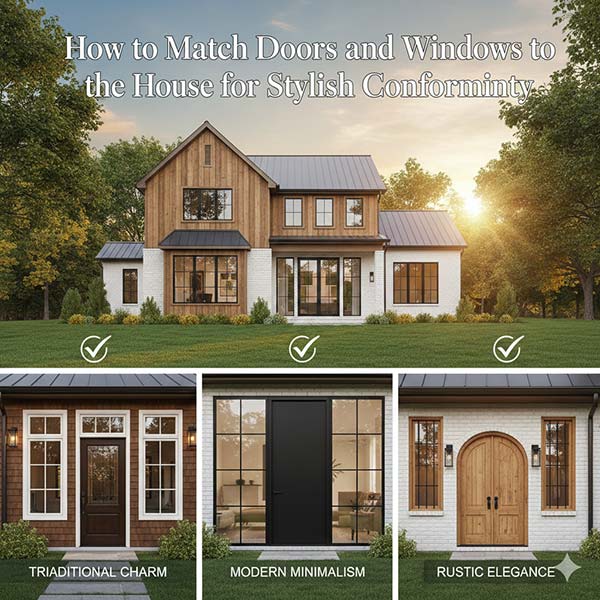
In the search for the ideal style for one’s home, there are also factors that are often underestimated. In addition to the furnishings, in fact, it is essential to carefully study the colours and finishing of windows and internal doors, as well as how they match each other and other elements in the house, such as the floor.
This article provides tips on how best to achieve such combinations.
Why combine doors and windows inside the home
Whether you are designing your house from scratch or thinking of renovating your home in a more modern way, there are many elements to think about in order to create a home that conforms to your style preferences. Windows and doors mainly have a pratical function, but they can also significantly influence the look and feel of the house.
After choosing a quality window and door, i.e. one that guarantees maximum technical and functional performance, it is therefore essential to choose colours and finishes that match the rest of the house. All with a view to achieving a coherent, harmonious and well-balanced visual impact that never tires over time.
To achieve this harmony, in fact, internal doors and windows must be well matched to the elements of the house in terms of materials, colouring, finishing and, ultimately, overall style.
This is very important, also because replacing windows and doors or changing their colouring at a later date could result in excessive costs that may be worth avoiding. As the operation is delicate, it is advisable to rely on a professional; this can be an interior designer, but also the manufacturer and supplier of internal doors and windows, such as METRA Building, who can provide the appropriate stylistic advice.
How to combine doors and windows with each other
It must be assumed that, as always, there is no one-size-fits-all formula. Everyone has to be able to respond to his or her own preferences and needs, which is why specific, customised advice can be decisive.
Nevertheless, some tips can serve as guidelines to start thinking about the subject.
Doors and windows: same or different?
First of all, although it is not an ironclad rule, windows and doors should be the same in all rooms of the house for stylistic consistency.
Of course, you can vary the version according to you needs. For example, some rooms in the house may have more need of a bottom hung opening, while other rooms can be fitted with sliding windows and doors. But when it comes to colours and finishing, identical windows give the house a continuity that is synonymous with elegance and good taste. This applies even more so in cases where elements such as walls, floors, skirting boards and large furnishings are different from each other and are in themselves elements of contrast. In this case, aluminium windows and doors are ideal because they allow you to choose from a very wide range of colours and finishes: it will therefore be almost impossible not to find the solution that fits your home perfectly.
As far as internal doors are concerned, on the other hand, the discourse is the opposite: they do not all have to be the same inside the home. For example, in the sleeping area one can choose doors with a more traditional style, while in the living area one can opt for more showy doors, true furnishing accessories: glass doors, double glazing doors, lacquered doors or doors finished in particular colours. Other rooms, such as storage rooms and closets, will instead require the use of more serviceable doors, such as folding doors to save space.
Instead, doors and windows can be combined according to a wide variety of preferences. For example, some choose to colour and finish all the windows and all the internal doors of the house in the same way, perhaps in a neutral colour that contrasts with more distinctive floors and walls.
Others choose the more classic solution: windows equal to each other and doors equal to each other. Still others choose to produce a contrast between the colours of the windows and doors, combining dark doors with light-coloured doors or vice versa. In the latter case, it must be borne in mind that the darker coloured element will be the most eye-catching.
How to match doors and windows to the floor
As true design elements, it is only natural that doors and windows should be combined with the other basic elements of the house, such as the floor and walls. The aim, as we have seen, is to create an environment that is consistent in style and, consequently, comfortable to the eye.
First of all, we need to be clear about the wide range of options for doors and windows; only in this way can we have a better idea of the preferred models that best match the rest of the house.
For example, windows can be made of different materials, each providing a different feeling to the room. While PVC is not usually preferred from an aesthetic point of view as a film-coloured plastic material, wood is the material of choice to give the home a feeling of warmth, cosiness and comfort.
Aluminium, on the other hand, is the material of choice for those who wish to live in a modern, contemporary, refined, minimalist home. Thanks to the enormous range of colours and finishing in which it can be made, it is in fact able to adapt to many living styles (as we will see below).
As wood is less performing than aluminium in terms of resistance to atmospheric agents, if you don’t want to give up wood you can opt for a combination of the two materials. METRA Building’s aluminium-wood line, for example, provides the maximum benefits of both: the warmth of wood on the inside and the maximum performance of aluminium on the outside.
As far as internal doors are concerned, here too there are many different styles. They can not only be made of different materials, such as aluminium and wood, but also include special finishes, such as lacquered or opaque, or the presence of glass cutting inserts in a wide variety of cuts. METRA Building’s catalogue of internal doors can offer a good overview.
Doors and windows combined with dark floors
Usually, dark floors tend to be combined with light-coloured doors and windows. This contrast not only lends character to rooms, but also avoids an overly sombre effect within the home. One can therefore opt for all shades of white, beige, dove grey and light grey. In particular, a white and shiny window and door gives a feeling of sophistication when combined with a dark floor, while a wood tone can be preferred for a more classic home with dark parquet flooring.
Among the colours available for customising aluminium windows and doors, there is also a whole range of pastel tones or, on the contrary, very vivid and bright tones, ranging from red to yellow and so on. Whether pastel or bright, the colours can provide the house with a unique personality. In this case, however, it is a good idea to rely on a professional to help balance the desire for uniqueness with a sensible colour combination that does not tire over time.
Doors and windows combined with light-coloured floors
With light-coloured floors, it is possible to play more with the colours of doors and windows.
In this case, in fact, you can either stay with natural tones such as white or light wood colour, or create strong colour contrasts, for example by choosing black or anthracite-coloured windows and doors. In the latter case, it is good to remember that dark colours give a lesser sensation of brightness; if we want to obtain bright environments, therefore, it is better to opt for lighter colours (especially in small houses), or choose aluminium, which allows for thinner windows and doors for a greater passage of light.
Again, with the help of a professional eye, very colourful windows and doors can be realised, especially in rooms such as children’s grooves or in houses with an eclectic style. A brightly coloured door or window can also be a good idea in cases where the floors and walls are totally white, so as to soften the cold effect and give the room a lively feel. Considering floor, walls, doors and windows, the general advice is always to choose a maximum of three different colours in order not to lapse into bad taste.
How to match windows to house style
As has been repeated several times in the article, it makes sense for windows to be chosen according to the style you want for your home.
With the same colours, finishes and combinations with doors and floors, in fact, what counts above all is conformity of style. Regardless of the preferred style, the aim is to find harmonious and balanced solutions that guarantee timeless elegance.
How to combine doors and windows in the classic style
Classically styled houses usually have high-quality floors, such as parquet or marble, as well as wood finishes and delicate fabrics. In these cases, doors and windows can be made of wood, the material that gives warmth to the house, in a shade that combines perfectly with the other woods present. In fact, a mixture of different types of wood should be planned in great detail to avoid messes; it is better to go for the same wood.
The doors can be made of wood, but also of aluminium, in white or beige, or, in any case, in natural lathes. Rounded glass inserts can also be inserted for added refinement and uniqueness.
As we have seen, wood is a valuable material that, however, does not guarantee maximum performance in terms of resistance. For windows and doors, one can therefore proceed in two ways:
- choose aluminium-wood windows and doors, thus keeping the wooden part inside the house but ensuring strength, practicality and durability on the outside;
- choose high-performance aluminium windows and doors to be enhanced with a wood-effect finishing. METRA Building’s wood-effect finishes, for example, ensure maximum resemblance to the real material and allow aesthetics and functionality to be combined.
METRA Building doors can also be made of wood-effect aluminium, or with inserts in either wood of different woods or glass in a variety of shapes.
How to combine doors and windows in modern style
When we talk about ‘modern style’, we usually refer to environments that evoke feelings of refinement, minimalism, essentiality. The lines are straight and square, the colours are often cold in contrasts of light and dark; but the perception is anything but cold. In fact, these are houses that are perfectly welcoming thanks to the technicality of their materials, the softness of the fabrics, the uniqueness of the details, the integration of technology.
In environments such as these, with basic, compact colours ranging from white and dove grey to dark brown and black, aluminium doors and windows are the undisputed queens. The special feature of aluminium is also that it can undergo all kinds of finishes, as in the case of METRA Building’s modern Anodic or Inspiration finishes.
From the point of view of the minimalist style, aluminium is the ideal material also because, with its unique combination of lightness and strength , it allows the creation of windows and doors with very thin profiles, even with very large glass surfaces. This article explores the concept of minimal windows and doors.
How to combine windows with industrial style
If there is another architectural style to which aluminium doors and windows lend themselves beautifully, it is certainly the industrial style. As a lively and versatile metal, aluminium is the material of choice for those houses that hark back to the mood of old factories and New York lofts, in keeping with the birth and development of the industrial style.
In this case, considering the presence of brick walls and black or brown leather furniture as is typical in industrial-style homes, doors and windows can be chosen in black or anthracite grey aluminium. In this case, especially when combined with an opaque or raw finishing, they are the perfect combination of warmth and modernity. In this article we take a closer look at industrial style.
Aluminium: a stylistically versatile material
Light and strong, aluminium is the material of choice for the houses of the future when it comes to the choice of windows and doors.
This is true from two points of view:
- Aluminium has many advantages when used in window and door frames and doors (as well as entrance doors and shading systems). Resistant to atmospheric agents and temperature variations, it is ductile and flexible, guarantees a long service life, is very easy to clean and requires no maintenance. Thanks to the presence of the thermal break, it ensures the most adequate performance in terms of thermic insulation, thus contributing to the house’s efficient energy use.
- As we have seen in the article, aluminium windows and doors are able to harmoniously adapt to any environment and any style. This is due to its extreme versatility. Assisted by an infinite range of possibilities in terms of colours, effects and finishes, anyone can enjoy the high performance of aluminium without sacrificing their own style preferences.
The house of the future therefore welcomes aluminium as the material of choice for windows and internal doors. METRA Building aluminium windows and doors fit into this context and are capable of embellishing any home, from the most classic to the most contemporary style. And speaking of the future, we must at least mention the ever more pressing need for domotics. METRA Building windows and doors are all designed to be connected to the home automation system, guaranteeing convenience, safety and living comfort at all times.