

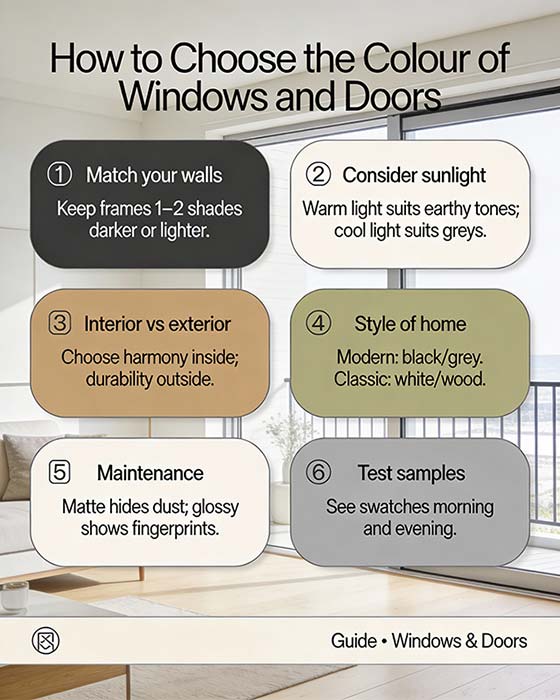
The colour of windows and doors can have a big influence on the aesthetics of a house, leading to a negative impact if it does not fit in with the architectural and design style chosen for one’s home. Understanding how to choose the colour of windows and doors is therefore very important. This article will show how to do this, providing useful tips in general and also according to the specific style of the house.
Why pay attention to window and door colour
Whether you are building a new house or renovating an old one, windows and doors are an element to be considered very carefully for several reasons.
Among the most important are certainly the technical and performance ones: a window and door must be of high quality in order to be able to protect the house from the weather and from possible intruders. It must also be able to guarantee excellent thermic insulation and equally adequate soundproofing. Especially aluminium windows and doors are ideal for performing all these functions at a very high level, while at the same time allowing the highest possible living comfort for tenants.
But choosing the right window and door also has a considerable impact on the decorative impression of the home, which is certainly not to be underestimated.
In particular, there are three elements that influence the aesthetics of the window and door and, consequently, of the rooms in general: material, colour and finishinig.
Having already delved into the features of different window and door materials (aluminium, PVC and wood), it is equally important to realise how the colour of the window and door can give the house a completely different look. One must take into account elements of harmony and cohesion or, on the contrary, of stark contrast and liveliness: choosing one direction rather than the other will also greatly upset the personality of the house.
Furthermore, windows and doors are like window frames, that is, what allows the house to dialogue with the outside world: the way in which windows and doors frame the landscape, thus assisting this dialogue, is equally important.
Finally, let’s not forget that the choice of window and door colour also has an impact on the external appearance of the house. It is therefore essential to choose the right colours, also in relation to the external walls and the environment in which the house is located, in order to be able to communicate the character of the home to anyone looking at it from the outside.
Aluminium: the best choice when for window and door colours
Even before understanding how to choose the colour of windows and doors, it is important to reflect on the material you want the windows and doors to be made of. The material, in fact, can also have a certain influence on the tightness and colour rendering of windows and doors.
For example, choosing PVC windows and doors in colours other than plain white may not be the best solution. In fact, PVC windows and doors are all made in white: if you want them in different colours, very thin coloured films are applied to them. The visual appearance is good but, over time, these films may discolour or peel off.
For those who want windows and doors with colours and finishes other than the standard plain white, aluminium is the absolute best solution. In fact, the colouring of aluminium windows and doors is carried out by painting (with non-toxic and highly resistant paints) or oxidation. Both machining processes ensure that the colour remains impeccably fixed over time, even up to 50-60 years after purchase.
10 tips for choosing window and door colours
This article explained in detail how to choose the best window and door for your home, taking into account all the more or less technical aspects of the window. Here, we delve into the aesthetic issue and, specifically, the choice of the best window and door colour.
- Define and assess the architectural style of the house
As mentioned, the window and door must conform to the general style of the house to ensure a sense of harmony and good taste. It is therefore important to be clear about the design style of your home, as each style has its own requirements in terms of colour. We will elaborate on this aspect later in the article. - Considering the colour of exterior walls
As far as the colour of the exterior of the window and door is concerned, it would be good if it harmonised with the colour of the exterior walls. The ultimate goal is to achieve a cohesive appearance that is pleasing to the eye.
In this case, you can opt for different options according to your preferences. The first option is tone on tone, for example by choosing light colours to match light walls: white, beige, dove grey…
The second option is contrast: if the walls of the house are light, for example, one could choose black, anthracite grey, dark brown… Finally, one could also decide to dare for a contrast of colours, in order to obtain a more lively and eclectic look. The walls of the house, whether light or coloured, can in this sense be combined with windows and doors with a very strong chromatic impact: yellow, green, red… The important thing is to avoid an ‘eyesore’ effect by choosing colours that complement each other. You can get help from an expert in order to avoid combinations that you might later regret or that you might get tired of.
Of course, if you live in a block of flats, there will be aesthetic constraints to adhere to, so you will not have much freedom in the choice of colour for the external parts of the window and door. In this case – or in case you still want two different colours even in a private house – the possibility of choosing different shades for the two parts of the window and door, the external and the internal, comes to the rescue. For example, in cases where a white window and door is required by the building but we want a dark one on the interior of our house, this is perfectly feasible. METRA Building aluminium windows and doors are in this sense the best choice, because two colours can be applied to the aluminium without any criticality. - Harmonising windows and doors with their surroundings
Unless there are historical or landscape constraints, everyone can choose the colour of external windows and doors as they wish. It is also true, however, that greater harmony is achieved when that colour fits well with the environment in which the house is located.
For example, a case located in a historical and elegant urban context would require windows and doors in soft colours, whether light or dark, avoiding very bright and shiny colours; colours that would be better suited to a more modern and lively city context. The windows and doors of a house set in a natural context, on the other hand, benefit from colours that are reflected in the tones of nature: green and all shades of brown for a house in the mountains, white and the different nuances of blue for a house by the sea, and so on. - Studying window and door exposure to sunlight
This may seem like a minor element, but in reality, there is a very close correlation between window and door and exposure to natural light.
For example, if we want a window to attract more light so as to increase the natural brightness in the home, then it might be a good idea to choose light colours, which tend to reflect light. Light colours could therefore be chosen in all those darker, dimly lit homes or rooms where there is a need to maximise natural light.
On the contrary, dark colours tend to absorb light, reflecting it to a lower dimension and thus diminishing the overall feeling of brightness. Dark colours could therefore be chosen without regret for windows with already strong natural light exposure. Furthermore, the ability of dark colours to absorb light would make them perfect for creating more intimate and cosy atmospheres. - Understanding whether you want the same colour for all windows and doors
As can also be seen from the previous paragraph, not all windows and doors have to have the same colour. While it is certainly easy to obtain different colours for the exterior and interior of a single window, different colours can also be chosen for the various windows in the house.
This is true not only as a matter of room brightness, but also so that the windows fit the different styles that different rooms might present. For example, if the case has a more rustic-looking kitchen and a more modern living room, one could opt for wood tones in the first room and dark, minimal colours in the second. The children’s groove or a hobby room, on the other hand, could have windows in brighter tones.
Surely, it is a matter of personal preference: choosing different colours for all windows and doors gives a dynamic look to the home, which will certainly not look dull. On the contrary, a more classic choice is to choose the same colour for all windows and doors: in this way, the house will have a more uniform appearance. - Delving into the features of light colours
As we have seen, light colours first and foremost have the ability to reflect light better, thus increasing the feeling of brightness in internal environments. They also attract fewer insects and are able to make spaces appear much larger and more airy.
On the other hand, the disadvantage of light colours is well known: they are shades that tend to soil more easily and therefore may require more frequent window and door maintenance1 and cleaning. However, this negative aspect is minimised if one chooses windows and doors made of aluminium, a material that requires very little maintenance and cleaning.
In the case of light colours, there are many shades. White is the light colour par excellence but, depending on all the other decision variables, one can choose light colours such as cream, beige, pearl grey, dove grey, silver, light wood colour. If you want to give your home a decidedly personal touch, while maintaining the airiness and brightness of light colours, you can opt for pastel colours: lilac, pale yellow, light blue… - Delving into the features of dark colours
The advantages and disadvantages of dark colours tend to be the opposite of those of light colours. Certainly, they are colours that soil less easily, or at least need to be cleaned less frequently without losing the clean feeling in the home. Furthermore, they are colours that give the home an instantly sophisticated and modern look.
On the other hand, dark colours tend to absorb light, reducing brightness and making spaces appear slightly darker and smaller than they are. This negative aspect, however, can be minimised by choosing aluminium windows and doors which, thanks to the strength and lightness of this material, have very slender profiles that let light through more easily.
If you like dark colours, you can choose shades such as black, anthracite grey, and dark brown. For a more fancy touch, other interesting dark colours can be deep blue, burgundy, forest green or rust orange. - Choosing combinations, contrasts and strong colours wisely
There are also aluminium windows and doors in bright, vivid colours: from yellow to green, from red to light blue, passing through orange and violet. These bright colours must, however, be used sparingly if an overly eccentric effect is to be avoided. Certainly, when dosed and mixed with more sober colours and design elements, they contribute to giving a strong personality to the home.
The same can be said of contrasting colour combinations when choosing window and door colours in relation to the walls and internal doors of the house2 : although they should never be too bold, they certainly help to create interesting visual effects in one’s home, while also helping to soften or accentuate a certain character. For example, choosing white windows and doors to match grey walls helps give the home a clean, essential look. When you have white walls, on the other hand, the use of dark colours for windows and doors gives the house a touch of elegance and sophistication. Remember that if you want to choose contrasting colours between window and door frames and internal doors, the element with the dark colour will be the most eye-catching. - Spend some time searching for the right inspiration
After considering all the aspects seen so far, it can be very useful to carry out a more or less extensive search for the right inspiration. This is all the more true when you do not yet have a clear idea: looking for pictures of houses with a similar style to ours and observing what colours have been chosen for windows and doors can help to clear your mind.
Such a search can easily be done on the Internet by typing into Google or using image search engines such as Pinterest. Or, one can request catalogues from window and door installation companies. METRA Building’s portfolio of residential realisations can be a good starting point, especially for those who have a modern, contemporary style home (but not only). - Experimenting with samples before making the final decision
If you have chosen your trusted window and door retailer but are still not totally sure about the colour for your windows and doors, you can request colour samples to take home. These samples are very useful to see how a certain colour behaves not only in the showroom or in the catalogue, but above all in the environment in which it will be found in reality. One can in fact closely examine how colours appear in different light conditions, and how they match with other elements in the home.
How to choose the colour of windows and doors according to the style of the house
Although there are several elements to take into account when choosing the colour of windows and doors, the style of the house is certainly a preponderant feature to be analysed. Different colours can produce a different aesthetic impact: it is a good idea to adapt this impact as much as possible to the architectural and design style of the home to ensure harmony and cohesion.
Classic or colonial style
The classic style is distinguished by its timeless elegance. In houses of this style, more traditional colours such as white, beige, ivory and cream are certainly the most suitable. Soft colours of this type emphasise the refined feel of the house, integrating perfectly with any decorative details that may be present (mouldings, cornices, stuccoes).
Modern and contemporary style
In the modern house, it is the dark colour that immediately conveys a sense of elegance: one can therefore opt for black or anthracite grey windows and doors, perhaps playing with opaque finishes. These colours, apparently bold but actually very sophisticated, harmonise very well with the materials usually used in modern houses (glass, metal, concrete).
Industrial style
Definitely modern, the industrial style is inspired by spaces that are typically industrial, such as lofts or former factories converted into homes. Raw materials such as metal, wood, exposed brick and concrete are favoured, as is furniture with leather and faux leather elements to give the home an urban, no-frills look. All this is certainly matched with dark, striking colours: black, dark grey, rust. For a more whimsical touch, other dark colours such as red and burgundy could go well with this style.
Minimalist style
Increasingly in vogue in recent years, minimalist houses are characterised by materials and furnishings that evoke an idea of simplicity and functionality. Therefore, minimalist windows and doors in neutral colours are needed, which contribute to creating a calm and orderly environment where nothing is out of place. “Non-colours” are therefore to be preferred, whether in light tones such as white or pearl grey, or in dark tones such as black.
Nordic style
In its simplicity and clean lines, the Nordic style is somewhat reminiscent of the minimalist style. The difference, however, lies in the preference for natural materials and colours, which help maximise the entry of natural light and create a bright and welcoming environment. Green light, therefore, to all shades of white and light wood.
Shabby chic style
This style gives the house a vaguely rustic look, where elements are (or seem to be) salvaged from vintage markets; the final look is often romantic and charming. All pastel colours go well with these houses: one can stay with classic white or off-white, but also dare with less banal shades such as wisteria, sky blue or mint green.
Eclectic style
Finally, there are houses that are impossible to pigeonhole into a precise architectural style; they are houses that break the mould and are more suited to the owner’s unique personality. In these cases, you can indulge in all the colours on the colour scale: neutral colours, light or dark, if you want to balance the eclecticism of the furnishings for a slightly more sober atmosphere; bright, vivid colours, from red to green and beyond, to give the house an even more indelible character.
Choosing window and door colours with METRA Building
Choosing the colour of windows and doors is not to be taken lightly: you need to consider all the elements seen in this article, and take time to assess the many options available on the market. The ultimate goal is to create windows and doors that perfectly match the style of the house, both internally and externally, and help create the atmosphere you want.
To achieve this, you can rely on METRA Building: the windows and doors, all made from the highest quality aluminium, can be painted or oxidised to take on any desired colouring, making it possible to match aluminium windows and doors to any style4 .