

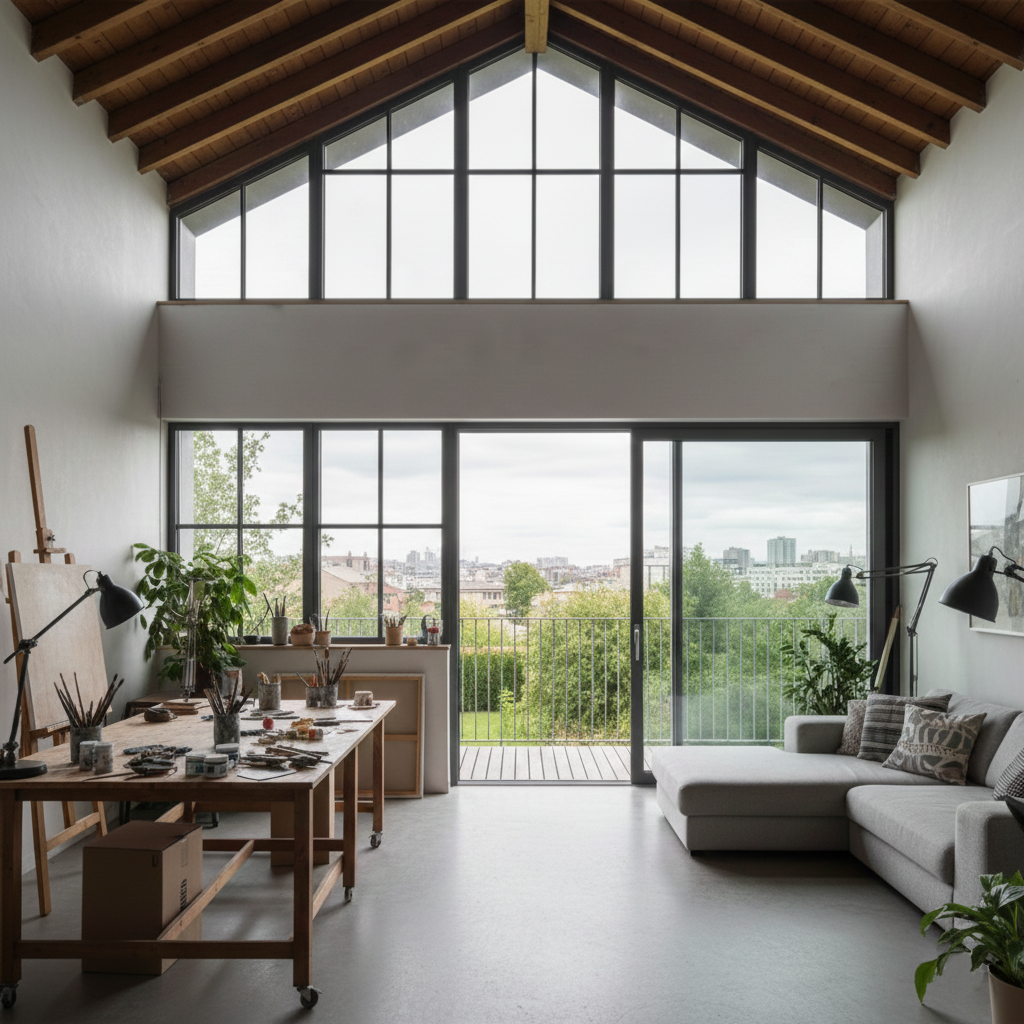
Replacing home windows is not a decision that can be made lightly: it is necessary to study well how and when to do it.
Indeed, it is important not to make mistakes that could affect the energy efficiency, safety, comfort and aesthetics of the home. This article provides some useful tips on the best time to replace windows.
The importance of living in a studio flat for organised
A studio flat is in almost no case a very large living space. Even if you live there alone and have no great pretensions, you have to recognise that every single square metre counts, and consequently you have to learn how to make the most of it in order to find the right balance between aesthetics and practicality. Moreover, numerous studies confirm that an orderly living, study and work space also leads to mental and emotional order, and this is all the more true in a compact environment such as a studio flat.
Here are 10 tips for optimising a studio flat and maximising its full potential.
- Exploiting all the advantages of multifunctional furniture
In a studio flat , there is easily not enough space for pieces of furniture with very different functions. If you don’t want to or can’t give up some of these functions, a smart move is to opt for multifunctional furniture. It is a smart solution to maximise space without compromising living comfort and freedom of movement.Some examples of multifunctional furniture to be included in a studio flat are:
- sofa-bed: for transforming the living room into a groove and vice versa, quickly and easily and always keeping the space tidy. The same result can also be achieved with an armchair-bed which, when closed, requires even less space;
- storage bed: the space under the bed can be skilfully used to store all those items that are needed but would not find space elsewhere (blankets, pillows, seasonal clothing…);
- storage bench: can be used in the same way as a storage bed, i.e. offering a space to store many objects under the seat. The same can be said for stools, ottomans and any piece of furniture that conceals a storage part inside;
- multi-use table: if well designed, a table can serve as a desk, a worktop for cooking, a dining table… Some modern tables can also be lowered to become coffee tables perfect for the corner of the studio flat;
- bookcase-dividers: these are shelving units or real libraries that remain open – and can therefore be used – on both sides. In addition to providing space for books, small objects and other useful furnishings, they have the advantage of allowing a cohesive and airy division of space.
In addition to multifunctional furniture, it is also interesting to make use of pieces of furniture that can be folded up to occupy less space when not in use.
This is the case, for example, of console tables that are very small when used by one person but can be extended to accommodate guests when needed. Or, similarly, folding chairs that can be tucked away and pulled out only when needed. - Creating more privacy with partitions
A library partition can be useful for subdividing spaces in a conceptual manner. If, however, the studio flat is large enough to be able to create closed, well-defined spaces, one of the most interesting solutions from this point of view is undoubtedly the implementation of partition walls. Partition walls allow for the creation of well-defined spaces, guaranteeing privacy and many other advantages, without affecting the flat’s masonry.Using partition walls makes it possible to create functional zones in the studio flat, making it neat and harmonious.
The alternatives are numerous:- “full” partition walls: they help to create a sense of maximum privacy. For example, one could install such a partition wall between the living and sleeping areas of the house; thus, the latter will remain well protected from prying eyes when one has guests.
- glass partition walls:they help to delimit space without sacrificing the sense of openness and airiness of the studio flat . Glass in fact does not prevent the view from spanning; this is at the expense of privacy, but a wall of this type could be installed where a division is needed even without the need to conceal certain areas of the flat. For example, a glass partition could be installed to delimit the kitchen corner, so as to protect the rest of the studio flat from any fumes or odours, but without interrupting the visual and spatial continuity. Or a glass wall could be used to create an office corner, perfect if two people live in the studio flat and work from home. METRA Building makes glass partition walls with an aluminium frame, a material with many advantages, light and resistant, perfect for supporting even large glass surfaces. Aluminium is a material that requires almost zero maintenance and cleaning, resulting in a studio flat to be lived in in a practical and functional way. METRA Building’s partition walls can be customised with casement and sliding openings, with or without frames, with fixed glazing, with the use of satinized glass, or with the application of window decals to make your studio unique. Their profile is only 50 millimetres: not too much space is wasted and natural brightness remains maximum.
- sliding partition walls: sometimes, it is necessary to opt for a subdivision of space that, however, allows a single room to be created when needed. In this case, there are sliding partition walls that can be moved easily.
An alternative with a very similar and more economical result than partition walls, although much more informal, is to adopt systems such as panels, screens, partitions or curtains.
- Favour light colours and light materials
The choice of colours and materials can make a big difference in the perception of space in a studio flat . A basic knowledge of colour theory is enough to know that light shades give the sensation of visually “opening up” spaces, as well as reflecting more natural light. Green light colours in all their variations: white, cream, beige, light grey, pastel colours…
These light shades, especially when they are neutral like white, also serve as the perfect versatile base for customising the studio flat with brighter colours. White walls, for example, visually expand the room and can be enlivened with touches of colour thanks to square spindles and posters. A light-coloured sofa, likewise, will not give the impression of being too overall dimensions, and can acquire personality through the use of colourful cushions in a variety of patterns.
Similarly, to give the studio a feeling of openness of space and liveability, one can choose light, ethereal materials that are not too bulky. For example, a transparent glass table seems to occupy less space than one made of solid wood; thin curtains lighten the room compared to a heavy drapery. To have the feeling of living in an airy and comfortable space, strong but light materials such as metal and aluminium are perfect for cabinets and shelves. With these materials, a modern and minimalist ambience is created, which can be complemented with aluminium windows and doors that give a feeling of lightness. One trick is to furnish the studio with furniture with a glossy or lacquered finishing, which amplify light and create a feeling of greater depth.
- Letting in as much natural light as possible
The entry of natural light is a fundamental element for many, regardless of the size of one’s home. In fact, a house that is very bright thanks to large windows and patio doors immediately looks healthier, more cheerful, dynamic and comfortable than a darker one. But if this is true for all houses, it is even more true in studio flat s, where natural light can really help perceive spaces as larger and cosier.
This article explains more about how to let more natural light into the home. Certainly, one of the best systems is to install aluminium windows and doors. In fact, this light but resistant material is able to support large glazed surfaces without the need for a very thick and bulky frame. Aluminium windows will therefore be characterised by slender profiles with essential and minimal lines, thus maximising the entry of natural light into the home.
To reduce the suffocating effect typical of small rooms and make the one-room apartment even brighter, the good work of aluminium windows and doors can be completed with light and ethereal curtains, to be kept open during the day within the limits of one’s needs. Finally, one can opt for shading systems, such as shutters or sunblades1, made up of adjustable blades that allow the entry of natural light into the home to be modulated.
- Creating functional zones through targeted lighting
We have seen how natural light is fundamental for managing the space of a studio flat . But it is not always possible to make use of it: it is not only the evening hours (or even the afternoon hours, in winter), but also the naturally darker days because they are cloudy. Some flats, then, are poorly oriented in space and, unfortunately, receive little natural light due to a structural issue. In all these cases, skilful use of artificial lighting is essential in a studio flat.
In a small room, it is important to visually define the different areas and make the room cosy. It can therefore be useful to adopt a combination of general, accent and functional lighting. For example, one can opt for a pendant lamp above the table, which creates a diffuse and well-lit light for cooking, eating and working. Near the bed, on the other hand, one can use wall lights or reading lamps, which produce precise light directed where it is needed. Adjustable spotlights and LED strips can be used to highlight specific details, such as a particular piece of furniture that gives personality to the studio flat , or create a general feeling of brightness.
The warmth of the light depends very much on personal taste, but bulbs with warm shades (around 2700-3000K) certainly create a cosier and less aseptic atmosphere. Following the same concept as multifunctional furniture, versatile lighting points can also be chosen, i.e. dimmable and/or easy to move, so that they can be used in different situations or times of day.
- Using mirrors to visually expand spaces
Another trick to visually expand the ambience of the studio flat is the use of mirrors. When strategically placed, mirrors reflect both natural and artificial light, helping to make the studio look bigger and brighter.
In addition to furniture with reflective surfaces or extra-gloss finishes, mirrors of different sizes can be placed on different walls of the studio flat . Similarly, mirror doors can be chosen for wardrobes, especially in the sleeping area of the flat.
- Maximising vertical space
In order to manage a studio flat and make it functional and cosy, it is now understood that the main objectives are twofold: to visually expand the space and maximise what we have available. From this last point of view, we must not forget that a studio flat also has vertical development: in such a small room, it can be smart not to leave the walls empty as they develop towards the ceiling.
In fact, if vertical spaces are usually ignored, in the studio flat they can become real allies for recovering space and organising one’s belongings.
Some examples? Shelves or hanging cupboards above doors or at the top of the walls. These spaces can be used to store useful things that are not used every day, such as suitcases or Christmas decorations. Similarly, it makes sense to opt for full-height cupboards and shelves, perhaps modular, so that everything is organised in an orderly manner. Finally, space on vertical walls (but also at the back of doors) can be maximised through the use of coat hangers and hooks: in the bathroom for towels, bathrobes and containers, in the kitchen for utensils of all kinds, in the lounge for jackets, bags and other accessories.
- Making use of colours and textures to subdivide spaces
A one-room apartment can often seem confusing, and therefore unwelcoming, because typical home spaces are mixed together: a single room serves as living room, dining room, bedroom and cooking area. If using partition walls or other dividing elements is not possible or is not within one’s preferences, one can still communicate a certain subdivision of space through the skilful use of colours and textures.
For example, painting the wall where the bed is located in a contrasting colour – perhaps blue, which facilitates feelings of calm and relaxation – immediately creates a clear pick-off between what is ‘day’ and what is ‘night’. On the floor, carpets can define the different functional areas of the home, perhaps including a larger one under the sofa, a smaller one near the bed and a runner in the kitchen area. The colours and materials of the furniture can also be chosen all similar for a general sense of cohesion or harmony, or all different to help create a subdivision of the different “rooms” of the studio flat.
- Becoming an expert in intelligent organisation systems
Often, one of the reasons why a one-room apartment is perceived as ‘stuffy’ is visual clutter. Clutter in the home never helps and has an impact on the serenity of those living there, their productivity and their sense of well-being. This is all the more true in the studio flat , where clutter also contributes to reducing the functionality of the spaces one has available. It is therefore essential to become masters of organisation, making the most of every corner and making tidying up and cleaning as easy and quick as possible.
Stackable containers, baskets, boxes, wall cabinets, as well as drawer organisers can be used to help divide objects in a clear and accessible way. On the basis of one’s habits, one can put the objects one uses least (at the back, at the top) in the most inconvenient places, while keeping those that are part of one’s daily life within capacity. It is also useful to catalogue the various organisers, e.g. with special labels, so that you always know where what goes and find a precise place for each object you own.
- Optimise external space, if any
If the studio flat has a terrace or even just a small balcony, it may be worthwhile to conceive and experience this outdoor space as a true extension of one’s own flat, thus recovering precious square spindle space. Within the limits of any condominium or landscape constraints, balconies can be furnished with folding tables and chairs, outdoor rugs, flowers and potted plants, aligned lights… The result is an extra space that can be used as a dining area or a corner to relax in.
If one has to get to grips with windows and doors in a modern renovation of a studio flat , it is an excellent idea to choose sliding aluminium patio doors. As we have seen, aluminium window and door profiles are thin and do not take up too much space, as well as obviously providing many other advantages (weather resistance, thermic insulation, energy saving, customisation of colours and finishes, and so on). Choosing the sliding version helps to avoid flooding an already reduced space with the opening of the sashes.
Bonus tip: customise as much as possible
These we have given are general tips, but every studio flat has its own square footage and its own arrangement of space.
Everyone can make their own the advice that best suits their situation, with the aim of maximising the available space and visually expanding it. It is very useful to opt for customised solutions and made-to-measure furniture – such as a bridge wardrobe above the bed or a cabinet under the windows – according to one’s needs.
A beautiful and functional studio flat with aluminium windows
Thanks to these tips, any studio flat can become a cosy and practical space, free from that unpleasant sense of suffocation typical of spaces that are too small, disorganised and poorly maintained. We would like to reiterate the advice to rely on aluminium windows and doors, in case you are building or renovating a studio flat , or simply want to replace the windows and doors.
Aluminium is a wonderful material if you are building a studio flat:
- practical (aluminium is an easily cleaned and maintenance-free material);
- light (aluminium allows windows with thin profiles, which let in more light);
- efficient (thermal break aluminium windows and doors eliminate heat bridges and maximise the energy efficiency of the house, resulting in reduced environmental impact and increased energy savings);
- safe (aluminium withstands very well the harshest weather without ever deteriorating, and it is much more difficult to break by attackers than other materials);
- beautiful (thanks to the painting and oxidation processes, aluminium doors and windows can be treated in a wide range of colours and finishes to match the style of the studio and give it a unique personality).