

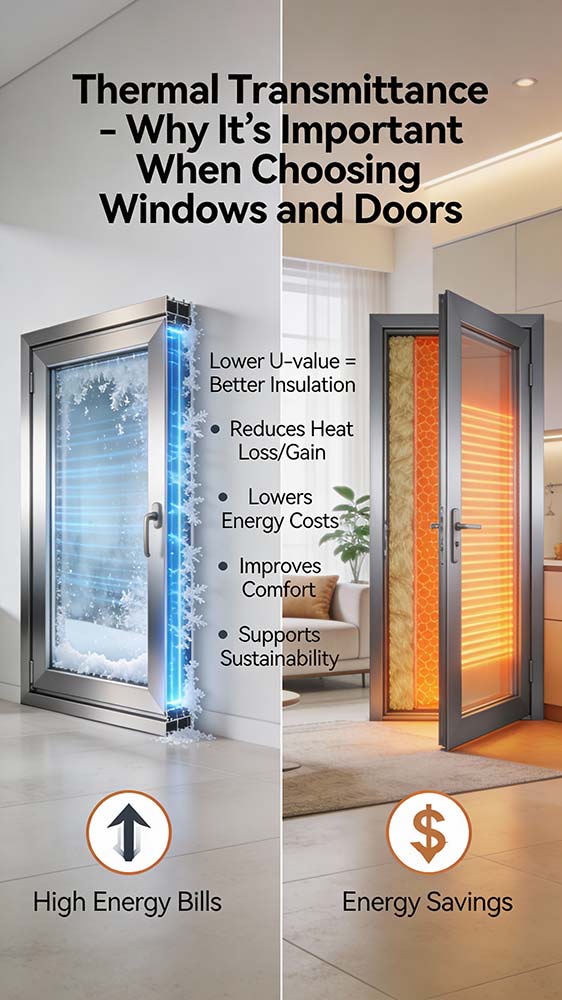
Anyone looking for information on how to improve the efficient energy use of their home, or who is simply looking for new windows and doors, will probably have come across the term ‘thermal transmittance’.
Understanding this physical quantity is essential for making informed choices, but it is often frightening because of its technicality. The aim of this article is to explain what thermal transmittance is and what it is used for when choosing windows and doors, in simple, understandable language.
Why thermal transmittance is important
Before we even understand what thermal transmittance is and how it is calculated, we need to understand why it is so important.
Knowing what thermal transmittance is can make all the difference in choosing quality windows and doors that will increase living comfort in the home and save on energy costs for space heating and cooling.
Indeed, a window with a low thermal transmittance value helps keep heat inside the house in winter, reducing the need for heating. Similarly, in summer, a window with low thermal transmittance reduces the entry of heat from outside, thus reducing the need to turn on air conditioning too often.
To sum up, knowing the concept of thermal transmittance and giving it value when choosing a window and door is particularly relevant for:
- increasing comfort in the home or office: if the temperatures are more steady and the micro-climate within the space is maintained at an ideal level, one finds oneself living, studying and working in much more cosy and comfortable spaces.
- saving energy: if the window has a good value of thermal insulation, it increases the thermic insulation of the house, in all seasons. Less heat loss or fresh air means less consumption and, consequently, lower bills.
- doing good for the environment: energy saving is a closely related concept to that of energy efficiency, i.e. the intelligent and judicious use of energy. High-performance windows and doors from the point of view of thermic insulation not only save energy, but also help to lower energy consumption for heating and air conditioning, which, as is well known, have a considerable impact on the environment.
- be compliant with relevant regulations: if you are building a new house or renovating one in a modern style, you need to be aware that thermal transmittance is one of those values subject to legislation. In fact, there are some regulations – at national and European level – that impose maximum thermal transmittance limits for windows and doors installed in new or renovated buildings. In this case, it is more important than ever to turn to professionals in the window and door sector, such as METRA Building, to ensure compliance with all regulatory requirements.
- accessing Tax Incentives: thermal transmittance directly affects the efficient energy use of a house. For this reason, many building industry bonuses are only granted for the purchase of windows and doors that meet specific thermal transmittance values.
Thermal transmittance: what it is and what it is for when choosing windows and doors
Let us now understand what thermal transmittance is in concrete terms.
It is a physical dimension that determines how much heat passes through a material or building element under standard conditions. When it comes to windows, this dimension represents the amount of heat – i.e. thermal energy – that dissipates from one side of the window to the other according to a series of parameters:
- for a specific unit of time;
- per square metre;
- per degree difference between external and internal temperature.
Heat transmittance is denoted by the symbol U and its unit of dimension is W/m2 K (i.e.: watts per square metre per kelvin).
The concept of thermal transmittance applies to any building material that provides a point of contact between the internal and external environments of a house: walls, roofs, floors, etc.
However, as poor-quality windows and doors can be the real weak point in a house’s insulation, it is essential to assess their value of thermal insulation even more carefully to avoid choosing poorly insulating windows and doors.
How does thermal transmittance work?
In a nutshell, thermal transmittance indicates the dispersion of warm or cool air from the inside to the outside of the window. Accordingly:
- a low value of thermal transmittance means that the material from which the window and door is made is very high-performing from the point of view of thermal insulation, as there is very little dispersion of heated air (in winter) or cooled air (in summer) to the outside.
- at the oppposite, a high thermal transmittance value means that the dispersion is high, so the window does not insulate effectively, it does not keep warm or cool air inside, but disperses it more towards the outside.
When choosing a window and door that performs well in terms of thermal insulation, one should therefore look for a value of thermal insulation transmittance that is as low as possible. This also depends on the requirements of the house and the surrounding space (e.g. the average temperatures and climate of the place where the house is located) but, in general, the aim is to choose windows that are able to provide excellent thermic insulation.
This will help us achieve the results seen at the beginning of the article. In particular, a house that ensures adequate living comfort, with rooms that are comfortably warm in winter and cool in summer, without wasting energy and money on excessive heating/cooling of the air. In fact, in a well-insulated window and door, heat or fresh air remains inside the rooms, thus reducing the excessive need for heating or air conditioning.
How is thermal transmittance calculated?
To calculate the thermal transmittance value of a window, its two main elements must be considered:
- the frame: the different materials from which windows are usually made, such as aluminium, PVC and wood, have different insulating properties. We will see shortly in the article why thermal break aluminium can be the winning solution when choosing well-insulating windows and doors;
- >the glass: the quality and type of glass (double glazing, triple glazing, insulating gas, etc.) greatly influence the thermal transmittance value.
To determine the U-value of a window as a whole, the individual U-values for the frame and glass are calculated, and then a weighted average of the two values is used, taking into account the relative surfaces of each element. Other small factors must also be taken into account in the overall calculation, such as the presence of any thermal spacers or the type of installation.
The general formula for calculating thermal transmittance is:
U = 1RU = \frac{1}{R}U = R1
where R represents the total thermal resistance of the component. The latter is the result of the sum of the thermal resistances of each layer making up the window and door; in the case of double or triple glazing, the air space (or gas) between the panes of glass is also taken into account, of course.
Thermo transmittance and thermal break aluminium windows and doors
In the past, aluminium was seen as a low-quality material for windows and doors because it is a good thermal conductor. A pity, because aluminium has numerous other advantages that are ideal for window and door construction.
Today and for several decades now, the problem of thermal insulation has been totally and definitively overcome thanks to the introduction of thermal break; we can finally say that aluminium is the absolute best material for windows and doors, guaranteeing excellent thermal insulation and more.
As explained in detail in the article on thermal break, the latter consists of inserting a highly insulating material – generally a thermoplastic material or a noble gas with insulating properties – inside the window frame, i.e. between the internal and external profiles. This layer acts as a very effective barrier to heat transmission (or fresh air); in this way, the thermal transmittance of the aluminium window and door reaches a very low value, ensuring excellent performance in terms of thermal insulation and very low loss of heat. Thermal break therefore helps to improve the window and door’s efficient energy use, without in any way sacrificing the extraordinary structural and aesthetic properties of aluminium.
The advantages of aluminium: thermic insulation and more
The thermal break, present in all aluminium windows and doors offered by METRA Building, gives this material very low thermal transmittance values, perfect therefore to ensure that one’s home is adequately insulated. This leads to long-term energy savings and greater energy efficiency, compatible with respect for the environment and Italian and European energy regulations.
From the point of view of thermic insulation, the thermal break makes aluminium enormously competitive compared to other materials commonly used for windows and doors, namely wood and PVC. In contrast to the latter, aluminium has no defects and can be used in the choice of windows and doors without any second thoughts.
In fact, while wood requires laborious maintenance and PVC tends to lose its aesthetic qualities over time, aluminium guarantees perfect performance because:
- is a material that is extremely resistant to strong weathering and solar radiation, as well as to the coldest temperatures. It does not lose colour, corrode or deform;
- creates windows and doors with a very high durability, almost double that of PVC, precisely because of its high resistance. It is able to retain its shape and functionality for decades with almost no maintenance required;
- is ductile, flexible and easy to clean: aluminium is perfect for windows and doors to be installed in a house where functionality and practicality are paramount. Extremely easy to clean with a cloth and a little water, aluminium is capable of supporting even very large glass surfaces, with slender profiles for minimalist houses, and offering the possibility of letting much more natural light into the home effortlessly;
- is extremely customisable: thanks to painting or oxidation processes, aluminium window profiles can be declined in a very wide range of colours and finishes (sandblasted, polished, opaque, etc.) without losing quality over time.
Choosing aluminium windows and doors guarantees many other advantages, such as high soundproofing – thanks again to the thermal break – and an equally high level of security, thanks to the sturdiness of the material, which is very difficult to break into. Not to be forgotten, once again, is the environmental issue: it is an ecological and environmentally friendly choice, as aluminium is a 100% recyclable material and can be used for an infinite number of times, without affecting its enormous properties.
METRA Building aluminium windows and doors: low thermal transmittance and all possible advantages
METRA Building offers aluminium windows and doors in many versions (e.g. with different types of opening) and complete with a wide range of accessories, such as handles and reinforcements for greater security in the home. For those who like to live in a modern and practical home, windows and doors can be connected to the internal home automation system.
Thanks to the thermal break, METRA Building windows and doors have low thermal transmittance values, thus ensuring efficient energy use in addition to the other outstanding qualities of this material. This efficient energy use helps save on heating and air conditioning costs, but also reduces the CO2 emissions produced by the house, benefiting environmental sustainability.
Understanding the thermal transmittance value is essential to choose quality windows and doors: with METRA Building you are on the safe side, from the point of view of energy efficiency, living comfort and more.