

Efficiency and Health
Mould is a tenant that nobody wants to have in the house: it can have negative effects on health and, in the long run, can lead to structural damage.
This article provides more than 12 useful tips to prevent it, ranging from simple gestures such as daily ventilation to smart long-term investments such as installing the latest aluminium window frames.
Moulds and condensation: why they occur
When an accumulation of water vapour comes into contact with a cold surface, such as window panes, condensation is present.
Condensation forms due to excessive air humidity. If this happens temporarily, such as immediately after a hot shower, it is not a big problem. If, however, the humidity in the home is persistent, for example because there is no adequate daily air exchange, condensation may become chronic and lead to the proliferation of potentially harmful microorganisms such as mould or fungus.
Another reason for condensation is the low quality of the window frame, or an old frame that is gradually losing its insulating capacity. Wooden and PVC windows last about 20-30 years, aluminium thermal break windows guarantee good insulation for 50 years and more. Once the normal life span of the window has passed, it could happen that it becomes a thermal bridge, facilitating the passage of air between the inside and outside of the house and vice versa.
Mould arises as a consequence of condensation that is neglected for too long. Even if condensation is not visible, excessive air humidity can still lead to mould growth on walls in the vicinity of windows.
How to prevent mould from forming in the home: 12 tips
Mould is to be avoided at all costs in one’s home for three main reasons:
- compromise the aesthetic appearance of rooms;
- damage surfaces and can, in the long run, lead to structural damage that is difficult to repair;
- above all, they are a small but persistent threat to the living comfort and health of tenants, as they can cause allergies and respiratory problems.
In the management and maintenance of one’s own home, among the most important interventions to undertake are therefore those aimed at preventing the formation of mould and condensation in the home. Some of these interventions require a daily commitment, albeit minimal; in other cases, they are more or less structural interventions that represent an excellent investment for the safety and healthiness of the home in the long term.
Here are 12 tips to follow to prevent mould and condensation in the home.
- Airing the house daily
If it is true that high humidity in the home is one of the main reasons why mould and condensation form, the first thing to do is to lower this humidity level. In this sense, air exchange is essential, i.e. ventilating the rooms in the house to allow the humid, stale air to escape and the fresh, ‘new’ air to enter.
Air exchange must be carried out daily, even during the cold winter months.
Simply open all windows for 10-15 minutes every morning to change the air in each room. This is a quick and non-invasive operation, but it helps a lot to prevent condensation on windows and cold surfaces. - Installing Controlled Mechanical Ventilation (CMV) systems
The only disadvantage of ‘natural’ air exchange, i.e. opening the windows a quarter of an hour a day, is the dispersion of heat to the outside. During those 15 minutes, in fact, the warm air coming out of the heaters in winter (but the same applies to the cool air coming out of the air conditioners in summer) tends to disperse through the open windows. Even if it is only a few minutes, it is still an unpleasant waste of energy.
From this point of view, with the aim of making one’s home a model of energy efficiency, one can consider investing in a Controlled Mechanical Ventilation (CMV) system. Such a system consumes no electricity and has the function of allowing a continuous air exchange even without opening windows. In addition to this, the VMC system is also able to keep the humidity level in the house under control, contributing to the creation of an ideal indoor micro-climate at all times. This, of course, is essential so that mould and condensation do not form. - Avoid any obstacles to air circulation
In addition to the exchange of air through open windows or a controlled ventilation system, it should not be forgotten that air circulation takes place at all times within the house. This is a good thing: air must circulate constantly so that the probability of creating damp areas and, consequently, mould is reduced.
It is important to think about a good arrangement of furniture, which helps to keep the room healthy by promoting air circulation. For example, furniture should be placed at least 5 centimetres away from the walls, especially when the walls are in contact with the outside. In addition, care should be taken to leave radiators unobstructed in order to promote the even spread of heat.
Therefore, it is better to avoid placing furniture right in front of the radiator, or covering it with heavy curtains or other objects. Putting clothes to dry on top of or in front of the radiator also minimises the function of the radiator, favouring the accumulation of moisture in the air. - Choose windows with openings that facilitate air exchange
If you are renovating your home in a modern style and need to replace your windows and doors (this article explains how and why to do this), it is worth considering the opening of the windows you choose. Windows, in fact, can have many different types of opening, and some of them are perfect for facilitating air exchange.
Think for example of tilt and turn or bottom-hung opening, two types of casement windows that allow the sash to be kept open for a few centimetres. In this way, a slight but constant change of air is guaranteed, without compromising the internal micro-climate too much and without wasting too much energy in heat dispersion.
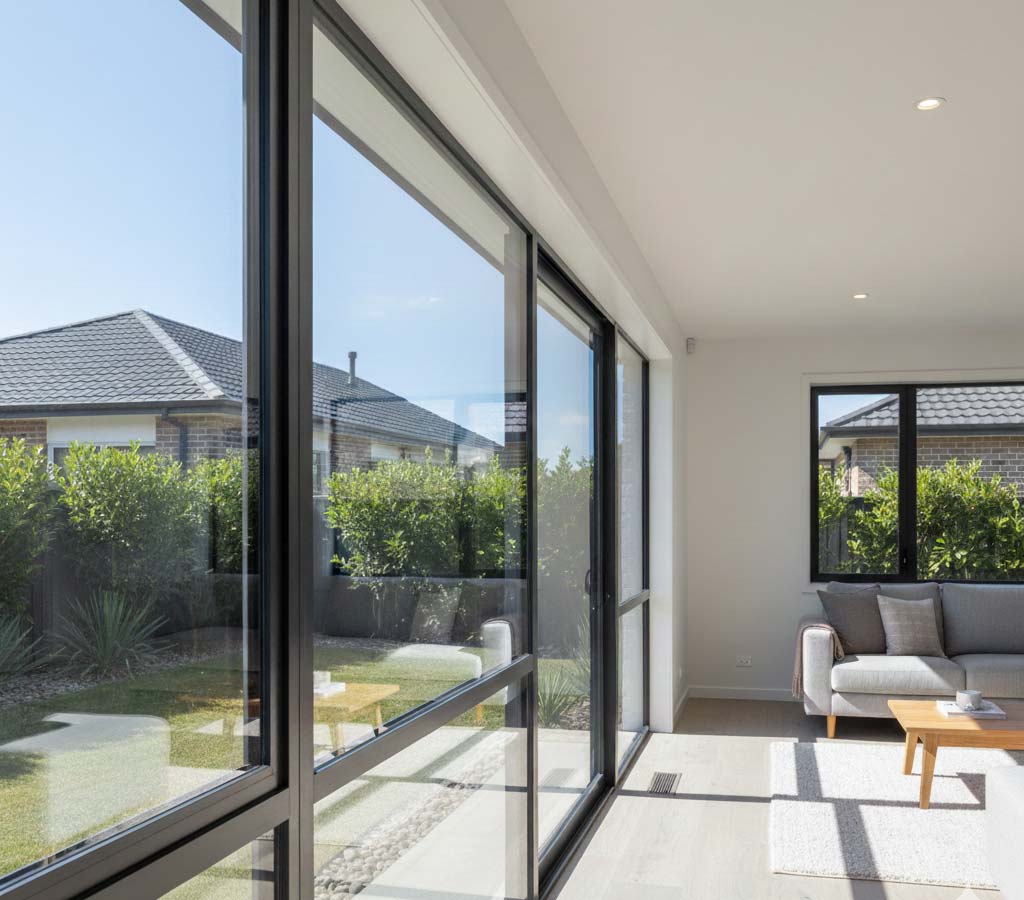
METRA Building, for example, manufactures high-performance aluminium windows, which also have a tilt and turn or bottom-hung opening. Windows of this type can be installed in different rooms of the house, but are particularly ideal for those rooms where moisture builds up most frequently, such as the bathroom, kitchen or laundry room. - Reducing sources of internal moisture
Bathroom, kitchen and laundry are definitely the rooms where the most moisture is produced. In fact, cooking, showering and drying clothes are all activities that produce large amounts of water vapour. Sometimes this is unavoidable, but small precautions can be taken to minimise the impact of such activities and keep the relative humidity level under control.
For example, if you notice that you are causing too much humidity when cooking, you can turn on the extractor hood while cooking. Again, you can arrange for a fan or dehumidifier in the bathroom to be switched on during or immediately after a shower or hot bath. Finally, if and when possible, clothes can be left to dry outside, for example on the balcony, or you can invest in a good dryer. - Maintain as constant a temperature as possible in the home
Temperature changes are a phenomenon that can lead to condensation, because it is precisely in the temperature difference that condensation of water vapour forms on cold surfaces, such as window panes. To avoid temperature fluctuations, one must therefore try to maintain a constant temperature in the home throughout the day; this not only helps prevent mould and condensation, but also ensures an optimal level of living comfort.
It is therefore advisable to maintain a constant indoor temperature between 19 and 22° C throughout the house. If possible, it is very useful to use programmable thermostats that can adjust the indoor temperature automatically, depending on how the outside temperature varies. This helps to ensure thermal uniformity and also to avoid over-cooling of certain rooms. - Making use of dehumidifiers when needed
The relative humidity level in the home should always be below 60% if a healthy environment is to be guaranteed and mould and condensation are to be avoided. This humidity level may sometimes be too difficult to maintain, for a number of reasons related perhaps to the structural characteristics of the house or the daily habits of its occupants.
In this case, it may be a good idea to equip oneself with a dehumidifier. There are different models, from the smallest and most portable – useful for individual rooms or spaces – to fully-fledged integrated systems that regulate the humidity level of the whole house. If the humidity problem is not too serious, a portable dehumidifier to be kept in the rooms most prone to moisture build-up might be sufficient. - Check for seepage, and repair it immediately if there is any
One of the biggest and most serious causes of excessive moisture in the home is seepage from roofs, walls or fixtures. Even the smallest and seemingly harmless infiltrations must be treated immediately. f neglected, they could lead to serious structural damage that is costly to repair. At that point, mould and condensation could be just the simplest of problems.
To intervene in a timely manner, prevention is needed. It is therefore necessary to take regular (at least every six months) time to check the condition of the roof and external walls . Window frames, especially older and poorly performing ones, should be inspected frequently to ensure that there are no leaks or that the seals are not damaged. At the first signs of damage, it is definitely time to replace the window frames. - Treat potentially wettest areas with anti-mould paint
Another intelligent act of prevention is related to anti-mould paints. These are products that specialise not only in treating, but also in preventing the formation of mould on walls. Paints of this type contain specific additives to prevent the proliferation of mould and fungus, guaranteeing lasting protection of surfaces.
Treating walls with anti-mould paints can preferably be done during construction or renovation of the house, but also at a later stage. It may be appropriate to use these products not in the whole house, but only in the rooms most prone to damp (bathroom, kitchen, laundry room). This also extends to other rooms, especially on walls in contact with the outdoors, in the case of very damp geographical areas, obsolete window frames or rooms that are used and ventilated infrequently. - Clean the walls regularly
Often, walls are somewhat neglected in the process of extraordinary house cleaning. However, regular cleaning of surfaces helps to prevent the formation and expansion of mould, especially in the most susceptible places as seen earlier in the article (damp rooms, walls in contact with the outdoors). This is all the more true if one notices the first signs of mould: even if they are weak and seemingly unceremonious, one must act immediately because the proliferation of mould can be very rapid.
To clean walls for this purpose, specific anti-mould products that are easily found on the market can be used. Or, natural solutions such as white vinegar or baking soda (the latter, useful in the case of porous surfaces) can also be effective. Whichever remedy you prefer, it is always a good idea to seek advice from professionals to ensure that you are doing the right thing. - Properly insulate walls
On a structural level, one of the most important steps that can be taken to prevent excessive moisture (and thus the proliferation of mould) in the home is wall insulation. When building or renovating a house, the so-called thermal insulation is now an essential element that cannot be neglected. It helps to ensure adequate thermal insulation of the house, preventing heat loss and maintaining an optimal level of humidity.
The coat can be internal or external, and should cover not only the walls, but also the floor and the roof (i.e., all perimeter areas of the house that are in contact with the outside). If thermal insulation is too invasive, there are alternatives, such as the use of insulating panels inside wall cavities. - Choosing thermal break aluminium frames
Along with thermal insulation, this list of actions to be taken to prevent the formation of mould and condensation ends with the most important action of all: the choice of quality windows and doors. Windows, in fact, play a crucial role in the fight against mould and condensation. If they are old or of poor quality, in fact, they constitute a thermal bridge, becoming the weakest point of the house’s thermal insulation. Poorly insulated windows create an imbalance in the optimal level of humidity in the home, and the consequences with regard to mould and condensation are well understood.
The thermal insulation of a window is guaranteed by three main elements. The first is the glass: please refer to the guide on choosing glass, but suffice it to say here that there are several solutions (e.g. double or triple glazing) to ensure good thermal insulation.
The second is the material. Those most commonly used for window frames – aluminium, PVC and wood – all provide an excellent level of thermal insulation. But, with the same performance in this respect, aluminium window frames provide many other advantages, which are discussed in more detail in this article. While thermal break plays an optimal role in keeping the house well insulated from the outside in all seasons, aluminium protects the house from the weather, adapts to different architectural styles and lasts about twice as long as its counterparts.
Finally, the last fundamental element is the installation, i.e. the installation of the frames in their place. The frame must align perfectly with the walls and, in general, countless precautions must be taken to ensure that the contact points between the window and the walls are perfectly insulated. If this were not the case, the window’s insulating potential would be nullified. It is therefore essential to rely on the right window dealer, who can guarantee impeccable installation.
METRA Building, for example, performs a PosaClima installation, by far the most effective and popular.
Avoid mould and condensation with METRA Building window frames
Especially if you live in humid areas and especially in winter, it is essential to take certain daily actions, such as those seen in this article, to prevent the formation of mould and condensation. If you are planning to build or renovate your home, the potential formation of mould should be taken into account right from the start, so as to avoid having to solve this problem in the future. You can therefore invest in a thermal insulation coat right away to properly insulate the walls, roof and floor of the house. And above all, the right window frames can be chosen.
From this last point of view, the best choice is thermal break aluminium windows and doors. This product, in fact, guarantees a low thermal transmittance value, allowing the house to remain warm in winter and suitably cool in summer. This is good for the efficiency of the house, increasing energy savings and decreasing its environmental impact.
In addition to this fundamental aspect, METRA Building aluminium windows are the best investment from all points of view. In fact, aluminium is a light and resistant material, reliable in the face of the weather and the possible action of malicious persons. It does not corrode or deform, guarantees a long-life span and can be customised in a wide variety of colours and finishes to suit the style of the home. In short: aluminium windows and doors are the best solution not only to prevent mould and condensation, but to be able to rely on modern windows that contribute to a safe, comfortable and attractive home.