

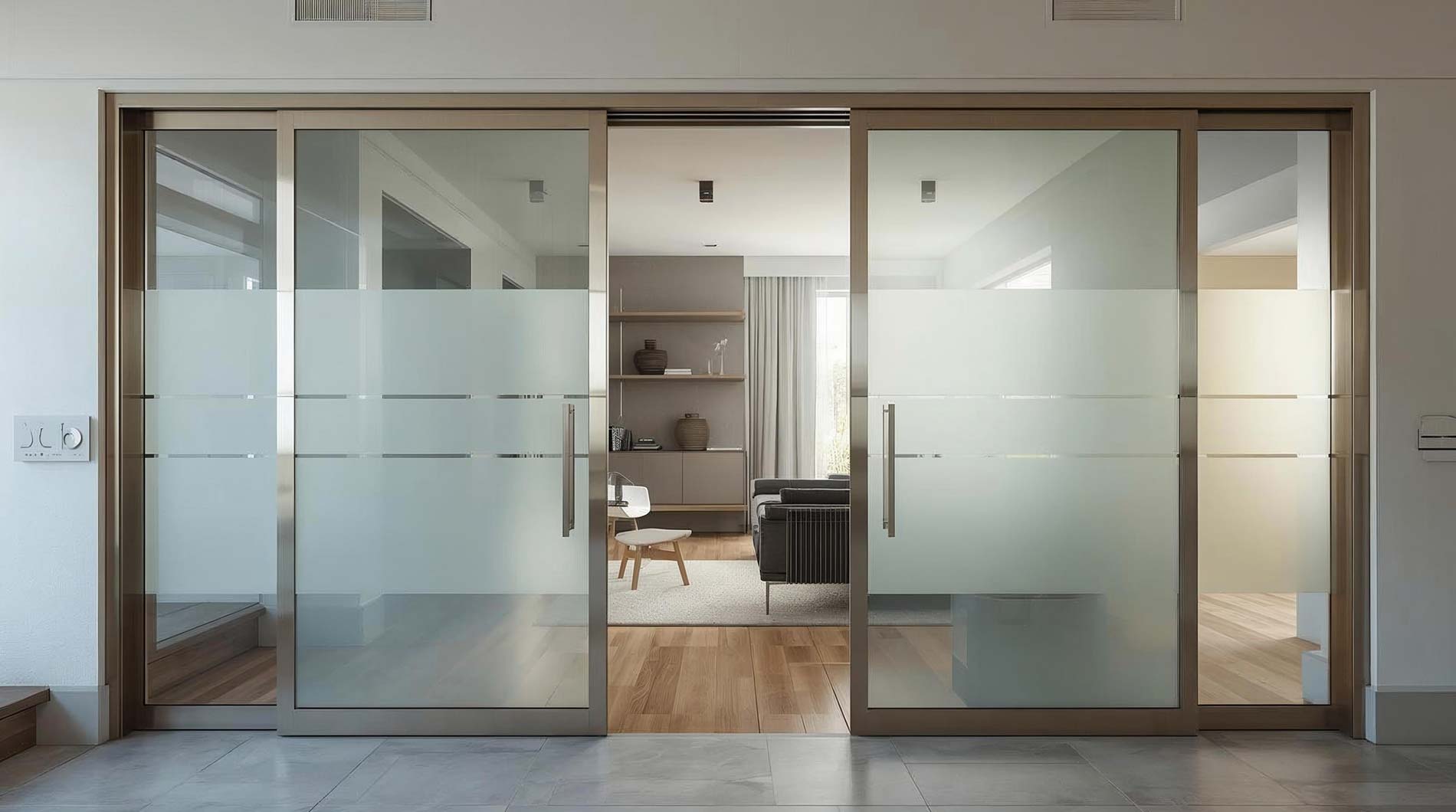
More space for your home
Although they are often somewhat underestimated, internal doors play a fundamental role in the organisation and aesthetics of a home’s spaces. This article focuses on sliding internal doors: what types are available, what materials they can be made from and why choose them for a home with airy, modern and well-distributed rooms.
Sliding internal doors: what they are and what types are available
When building or renovating a home in a modern style, internal doors are an element that must be considered very carefully, as they can greatly affect both the functionality and aesthetics of the home.
Choosing an internal door means first of all knowing the different configurations available. There are casement internal doors and sliding internal doors; among the latter, there are different types that meet different aesthetic, technical and functional requirements.
External sliding doors
This type of door slides along a track fixed to the outside of the wall. If made of metal, aluminium or with special finishes, the guides can become real design elements, giving character to the home according to different architectural styles. For example, external wall sliding doors in wood with aluminium guides are often used in industrial-style homes.
External wall sliding doors are the easiest to install and do not require invasive masonry work; they are therefore ideal for rooms that have already been renovated and furnished.
Pocket sliding doors
This internal door slides inside the wall thanks to an embedded counterframe which, once installed, becomes invisible; this is why it is called “concealed”. This is the cleanest solution and is best suited to minimalist environments, where maximum discretion of form is emphasised and modern, essential styles are enhanced.
Since installing a sliding pocket door requires masonry work, it is advisable to include it in the new construction or renovation project at the appropriate time.
Sliding doors with two or more
Whether external or concealed, sliding doors do not necessarily have to have a single sash. If space allows, a sliding door can also be larger, comprising two or more sashes and thus allowing for large openings. It is perfect for connecting and separating similar but different spaces when needed, such as the living room and kitchen, or the living room and study.
This type of sliding door fits well in the context of a large house, but can also be used in an apartment. In any case, it helps to create a dramatic effect and give the home a distinctive character.
Telescopic or folding sliding doors
If, on the other hand, you live in a small space, the most suitable sliding door may be one that opens onto itself, thus maximising the available space and contributing to the functionality of the home.
A telescopic sliding door has at least two leaves, one of which opens by overlapping the other. The folding door, which has been around for decades but is now available in contemporary and designer versions, consists of one or more leaves that ‘fold’ onto themselves, allowing the door to be opened completely even in walls of limited length.
Why choose sliding internal doors?
Sliding internal doors are a smart and versatile solution to ensure maximum liveability and improved comfort in the home.
Firstly, this type of internal door offers the advantage of saving space. Unlike more traditional casement doors, they do not require a large area for the sash to open. This makes them particularly suitable for studio flats, small offices and, in general, small homes. Even in the case of larger rooms, sliding internal doors allow for a more fluid layout.
A second advantage is their appearance: sliding internal doors allow you to give continuity to spaces or separate them with style and discretion, promoting brightness and a feeling of openness. Furthermore, especially if made of aluminium, they can be extensively customised in terms of finishes, colours and opening systems.
Finally, sliding internal doors are a modern and technologically advanced choice. The latest models feature elements such as soft closing, silent sliding and flush solutions. These doors are therefore well integrated into contemporary homes where technology and home automation are at the service of functionality and well-being.
When to choose an internal sliding door?
Here is a summary of when sliding internal doors are particularly suitable:
- you live in a studio or small house/apartment, where opening a casement would be difficult;
- you are looking for a solution for small or difficult-to-furnish spaces such as bathrooms, closets or corridors;
- you want to achieve maximum visual continuity and fluidity between rooms, creating a clear separation that does not weigh down the space;
- you want a minimalist and tidy effect, eliminating redundant elements such as jambs, frames and other overall dimensions;
- there is a need to make the home as accessible as possible. Sliding doors are generally easier to use for children, elderly people or people with mobility difficulties.
The best materials for internal sliding doors
Today’s internal sliding doors can be made from a wide range of materials to suit different needs and preferences.
One of the most common materials is wood: warm and traditional, it is well suited to classic, rustic or nature-inspired contexts. You can choose raw wood for an industrial home, or opt for lacquered or painted wood for more modern homes. An alternative is composite or laminated panels, which offer good aesthetics at a reasonable price. In this case, the internal sliding door can be customised with different finishes.
Nevertheless, the best materials for internal sliding doors are glass and aluminium.
- glass offers visual lightness and continuity between rooms, while maintaining physical separation. It is a material that gives spaces an immediate refinement, as well as maximising the passage of natural light. Glass can also be customised in different types (transparent, satinised, smoked, lacquered, decorated…) to suit different preferences and styles of home.
- aluminium is a lightweight, strong, recyclable and durable material. It is undoubtedly the ideal option for modern and contemporary environments with a linear and minimalist design. However, thanks to the different combinations of colours and finishes available, it can adapt very well to any architectural style.
When used together, aluminium and glass offer the maximum advantages of both materials: visual continuity and light transmission combined with a resistant structure and clean lines.
Aluminium: the ideal material for modern sliding doors
Internal sliding doors made of aluminium offer a unique combination of elegance, strength and lightness, perfect as both a technical and aesthetic solution in contemporary homes.
METRA Building’s internal sliding doors, for example, feature minimal profiles, high brightness and high-quality construction. With a smooth and silent sliding system, METRA Building doors adapt to any context: traditional or plasterboard walls, concealed or external wall systems, one or more leaves…
They can be made entirely of aluminium for a modern and refined look, or in combination with glass for greater natural light transmission. The finishes can also be extensively customised: from wood effect to anodised, from opaque lacquer to extra-glossy, with a wide range of colours to choose from. Finally, don’t forget the range of complementary accessories: handles, opening and closing mechanisms, carriages, gaskets(2) and corner cleats by METRA Building are all coordinated and manufactured to ensure maximum design and durability.
There are three other important reasons for choosing aluminium sliding internal doors:
- aluminium is a very resistant material, which tends to last a long time without deforming or losing its qualities. This makes it the ideal material for use in particularly humid environments or those subject to sudden changes in temperature, such as kitchens or bathrooms;
- aluminium sliding internal doors do not attract dust and are very easy to clean. All you need is a dry cloth and, occasionally, a mild cleaning agent. They are therefore perfect for practical and functional homes;
- aluminium is an environmentally friendly material. With low waste in the production cycle, it can be recycled 100% and an infinite number of times, thus significantly reducing its impact on the ecosystem.