

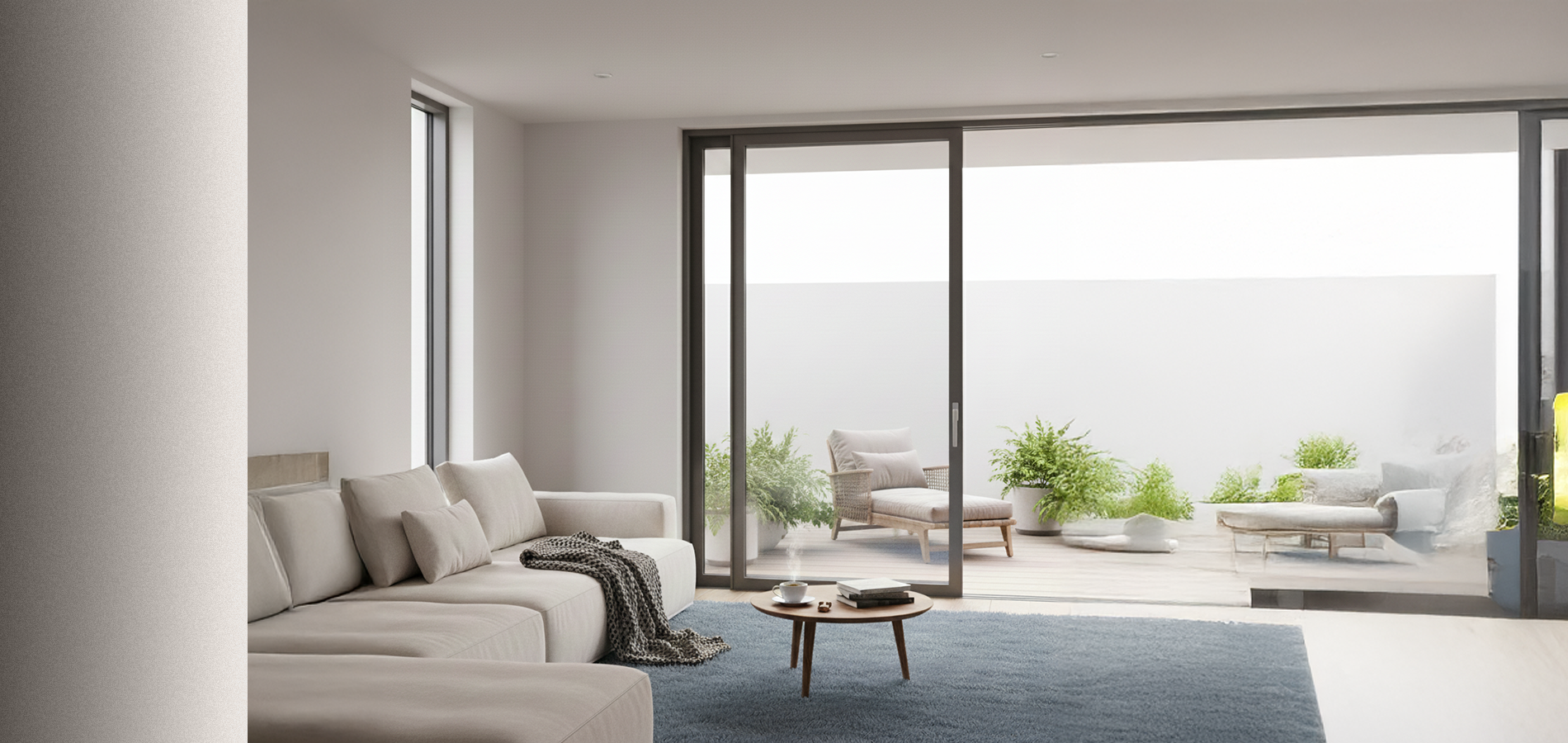
Minimal Style, Lighter Life
Furnishing homes in a minimalist style means embracing principles of simplicity, elegance, functionality and harmony.
This article explains what is meant by a minimalist style and provides some tips for furnishing homes in this style. Aluminium windows and doors will be the perfect complement thanks to their clean and essential lines.
Minimal Style: what it is and features
The minimal (or minimalist) style is an architectural and design approach that is characterised by its ability to eliminate the superfluous and to enhance the essential elements of structure and furniture. In this way, spaces are always bright, airy and also very cosy; in fact, if you furnish in minimalist style effectively, your home will be warm and comfortable even without too many frills.
The minimalist style has its roots in the modernist movements of the 20th century, such as the Bauhaus, in which form and function were inseparable. Today, minimalism is based on the fundamental principle that has found widespread acceptance in recent years in many areas of life: less is more. When it comes to furniture and design, this does not mean sacrificing aesthetic beauty and living comfort; rather, it means choosing furniture and decoration that always has an essential design and a well-defined function.
What is meant by minimal furniture
As a fundamental point, minimalist furniture emphasises quality over quantity. Each element must have its own purpose and contribute to creating a balanced and airy ambience that gives a sense of lightness and harmony. Minimalism is therefore not synonymous with modern style in home furnishing: when furnishing in minimalist style one can certainly choose modern and designer furniture, but the priority is rather to adopt a furnishing philosophy that focuses on the essential.
Here are some features of minimalist furniture:
- harmonious use of space: each room is designed to be open and airy, with few furnishing and decorative elements, thus avoiding feelings of heaviness and overcrowding. The removal of superfluous decorative elements generates a “visual cleanliness” and allows the eyes to rest, promoting a sense of calm and order;
- harmony between the elements: from materials to colours to textures, every detail contributes to the overall balance of the spaces. In a home furnished in minimalist style, no element is chosen by chance;
- geometric and simple lines: minimal furniture pieces have essential, clean shapes and lines, thus avoiding ornate or elaborate decorations. The perfect example is a sofa made of straight lines and upholstered in monochrome fabric;
- neutral colours and solid colours: in the minimalist style, the colour palette is dominated by neutral colours that amplify natural light and create a relaxing atmosphere. White, grey, beige and black will therefore prevail, even combined in different shades to add depth without breaking the chromatic harmony;
- natural and hi-tech materials: wood, glass and metal are the main protagonists of the minimalist aesthetic. To add touches of authenticity and refinement, other materials such as natural stone and polished concrete can be used. Among metals, aluminium should be mentioned, which, thanks to its specific features, fits perfectly into the minimalist context: resistant, light, versatile and flexible, it can be used for minimal windows and doors as well as for other architectural details.
Other typical features of the minimalist style are uncluttered spaces, minimal accessories and well-thought-out lighting. In essence, furnishing a home in minimalist style means creating an environment that promotes relaxation and well-being, simplifying everyday life and celebrating the beauty of the purest simplicity. If you succeed in furnishing in minimalist style so that each element dialogues with the others, you will achieve a home characterised by harmony, balance and timeless sophistication.
8 tips for furnishing your home in minimal style
Having framed all the main features of the minimalist style, here are some practical tips for furnishing your home in a minimalist way.
Choosing modern and functional materials
As seen above, the choice of the right materials is in itself an essential component for furnishing in minimal style effectively and correctly. One must first opt for quality materials that will protect the house from the pitfalls of time. The materials that can be played with most in the minimalist style are solid wood, glass and various metals. For example, a good choice is a light wood dining table with metal legs, for a contrast of ‘warmth’ that makes the room instantly elegant.
In particular, aluminium is the perfect material for those who wish to furnish their homes in a minimalist style.
Thanks to its lightness, strength and surprising versatility, it is ideal for making minimal windows and doors, internal doors as well as and other architectural details. For aluminium windows and doors, neutral colours such as opaque black, grey or white are recommended in order to obtain windows that integrate perfectly with the minimalist environment. You can also choose furnishing pieces such as coffee tables with aluminium structures and glass tops, or lamps with a dry aluminium structure and transparent diffusers for subtle, diffuse lighting.
Opting for a neutral colour latch
Neutral colours are perfect for the minimalist style for two reasons:
- facilitate the combination of different elements, thus contributing to the overall harmony of the rooms;
- give a sense of peace, serenity and ‘visual cleanliness’ to spaces.
A good idea is to start with light walls, possibly in pure white or light grey, to create a bright atmosphere.
From this base, contrasts can be created to give character to the home, for example internal doors or window and door profiles in black or anthracite grey. Those who prefer to avoid colour contrasts and stick to “ton sur ton” can add personality to the rooms by playing with different textures; for example, fabric cushions can be used on leather sofas. Using natural fabrics such as linen and cotton for cushions and curtains helps create an interplay of materials while maintaining colour consistency.
Reducing the superfluous
Essentiality is the cardinal principle of the minimalist style.
It translates not only into clean lines and the neutrality of colours and materials, but also and above all into the airiness of space. To furnish in a minimalist manner, therefore, one must think in terms of decluttering: remove furniture and superfluous decorative objects that have no real function or meaning, or that do not harmonize well with the rest of the rooms.
The library full of objects arranged in a somewhat confusing manner typical of the most classic houses, for example, should be replaced with simple and well-organised shelves, perhaps equipped with discrete containers that enclose everything that would be inharmonious to the eye. In this regard, hidden organisation is typical of the minimalist style: it is achieved by adopting integrated storage solutions, such as concealed drawers or wardrobes with smooth panels. Finally, minimalist houses often feature multifunctional furniture – such as a sofa-bed, a bed-container or a table-container – which help maximise space without compromising aesthetics.
Study lighting well
To enhance a minimalist space, it is essential to focus as much as possible on the entry of natural light into the home.
Natural light, in fact, maximises the concepts of airiness, lightness and harmony typical of minimalism. It is advisable to opt first of all for windows and doors as wide as possible; aluminium allows for windows and doors with very slender and slim profiles2, which facilitate and amplify the entry of sunlight. You can then choose transparent or panel curtains in light and neutral shades, as well as placing large mirrors in key points of the room to reflect light and visually expand the space.
When artificial light comes into play, it is worth choosing lamps with a minimal design, again with essential and simple lines. Indirect and diffuse lighting systems (such as metal pendant lamps) are preferable to create cosy but not heavy atmospheres, without excesses as befits a truly minimalist style.
Integrating invisible technological solutions
It is possible to make your home modern and up-to-date by adopting technological solutions that make everyday life more practical and functional. However, this must be done invisibly, so that the technology does not compromise the minimalist aesthetics.
A prime example of this is home automation, which allows people to manage their homes stress-free and conveniently thanks to technology. Many METRA Building products, for example, can be integrated into the home automation system, being controlled by simple buttons or voice commands in the presence or even remotely; but other elements of the home can also be controlled by home automation, such as lighting and internal temperature management.
Other invisible technological solutions can be hidden stereo systems (e.g., inside furniture in the living area) and embedded lighting; LED strips embedded in furniture or ceilings, for example, contribute to soft, modern lighting in an invisible manner.
Invisible innovation is also achieved in the area of windows and doors, for example by choosing aluminium windows with sliding mechanisms or pivot window , which offer greater opening without taking up space. Even internal doors, such as those from METRA Building, can feature invisible joint mechanisms (integrated into the wall) to perfectly suit a minimalist style.
Creating a focal point to give character
Often, there is a tendency to think that one of the negative features of the minimalist home is its lack of soul: cold, pick-off materials, excessive order in spaces. The secret lies in giving warmth and personality to rooms that remain, however, clean, airy and harmonious.
A good way to do this is to equip each room with an element that catches the eye and immediately makes the room unique and alive, but without weighing it down. Instead of many knick-knacks, for example, you can opt for a single valuable sculpture, or an important square spindle – perhaps abstract, with geometric or monochrome motifs – to be placed on a main wall. Or you can place an iconic piece of furniture, such as a sofa or armchair with a particular design, among the various neutral furnishings.
Softening rooms with plants
To add extra warmth to rooms and make them more hospitable and cosy, greenery can play a key role. Plants add a touch of freshness and vitality without compromising the essence of minimalism.
You can choose:
- plants with clean, vertical lines (Sansevieria);
- elegant and discrete plants perfect for filling empty corners (Ficus Lyrata);
- plants with large, sculptural leaves to create a strong visual impact (Monstera);
- minimalist plants for natures with modern-looking lines (Zamioculcas zamiifolia).
Plants should be placed in minimal spaces in a strategic and orderly manner, following geometric or symmetrical patterns to maintain visual harmony. It is also important to maintain colour consistency, for example by choosing flowers that fit well with the room palette, or leaves that harmonise with the tones of the house (dark leaves for houses with cold tones, leaves with yellowish hues for houses with warm tones).
Also, it is important not to overdo the plants so as not to overload the space: one or two plants per room are certainly sufficient in a minimalist home. It is equally important to ensure that the container fits in with the minimalist style so as not to create disharmony: you can opt for pots made of neutral materials such as white or black ceramic, concrete or metal, preferably without decoration and with sober lines.
Personalising the home without overdoing it
The home must reflect the personality of its inhabitants: even in a minimalist home it is possible to add your own personal touch without compromising the harmony and simplicity typical of this style. Personalising a minimalist home therefore means adding representative details while maintaining consistency: every choice must be intentional, contributing to an environment that is personalised but always elegant.
Here are some discrete but characterful customisation suggestions:
- personal photos on the walls: to be consistent with the minimalist style, simple, unadorned frames in neutral colours such as white, black or light wood should be chosen. You can create wall galleries of photographs arranged geometrically to maintain visual order;
- decorative objects: ‘less is more’ is a concept that applies very much in the context of home decoration. It is advisable to opt for a few decorative objects that are of quality and have a specific meaning for the person choosing them. Handmade vases, modern sculptures, travel souvenirs… the important thing is not to overcrowd the rooms and, if possible, to choose materials and colours that do not break the balance;
- books: books can become a popular decorative element in minimalist homes, especially if they have elegant covers and are placed neatly in libraries and on coffee tables;
- design objects: one can choose square spindles of contemporary art, graphic prints, but also design pieces such as sculptures or lamps that express one’s personal taste and give character to rooms;
- fabrics: the minimalist style requires moderation in the quantity of elements such as cushions, curtains and carpets. Remaining within the context of a minimalist quantity, one can choose fabrics that contrast with the rest of the furnishings, for example a soft plaid on a sofa with sharp lines, or a wool rug that adds depth. Breaking the monotony of colours with small coloured details, such as mustard or teal cushions, can also be a good solution. Plain colours or geometric patterns are best.
A house is more minimal with aluminium windows and doors
In addition to those given just above in the article, we would like to propose a last but very important piece of advice regarding the choice of windows and doors.
When building or renovating a house in a modern style, choosing windows and doors is an action that requires a great deal of attention not only for the functionality of these elements (resistance, protection, thermic insulation, soundproofing…), but also for their aesthetics. Even if we sometimes do not think much about it, windows have a truly remarkable aesthetic impact on rooms.
If you plan to furnish your home in a minimalist style to increase the sense of harmony, balance, lightness and brightness of space, then you should choose aluminium windows and doors. In addition to all its functional advantages, the decorative impression of aluminium suits all architectural styles but is simply perfect for minimalist homes.
Its quality as a light, flexible, versatile, sinuous and essential material lends itself to the creation of minimal windows and doors of the highest quality, especially if this is done by specialised companies such as METRA Building. Aluminium windows and doors feature space-saving profiles, with harmonious and elegant lines; they can be customised in a large number of colours and finishes, such as opaque, glossy or extra-glossy, which are perfect for a minimalist home. Among the colours in METRA Building’s RAL catalogue, you can choose many tones suitable for the minimalist style: from simple white to sand, beige, dove grey, anthracite, dark brown, black, and much more.
Embracing the minimalist style means adopting a lighter, more harmonious and conscious way of living, thanks to a home that is furnished with balance and elegance. In a minimalist case, stress is reduced, the functionality of space is improved and the deep connection with the space in which one lives is increased. In this context, aluminium windows and doors represent the best investment that will help transform a simple minimalist house into an oasis of well-being: warm in winter, cool in summer, energy efficient, protected from the weather and intruders, silent, extremely bright and elegant.